Showing posts with label baking. Show all posts

7.11.2011

Wheat sandwich bread

I've had a love affair with soft squishy white bread since since I was about 1 [note 1].  Sunbeam was best, but Wonder was ok in a pinch.  The crust is merely a darker version of the middle, it has a twinkie-long shelf life and it practically withers in the presence of moisture, but it's still a fine substrate for bolony with mustard, pb&j or sopping up bbq sauce.  Y'all like it more than you'll admit.


But, it is an enigma of baking.  I can buy this stuff if I want and occasionally do, but it is the challenge of recreating a recipe based on my perception and palate that drives the pursuit to duplicate it in my kitchen.  More importantly, once I get the gist of the soft bread, I could elevate it to something special and that is the reason for this post.  I have and I did and now I will share with you.


This is a straight dough method, mixing, rises and proof is as described in  Wayne Gisslen's Professional Baking.  Basically toss all ingredients in and mix and knead.  The big break in this loaf is the use of a softer (lower protein) flour to to blend with the unbleached white to afford a softer loaf.  Note: My preferences are to use a scale to weigh ingredients, a bread machine to knead, and I use instant (aka fast rising, any brand except Kroger) active dry yeast [note 2].


This particular loaf is the white bread version using cake flour.  The crumb and interior is the same for the whole wheat pastry flour variant.  When I get an image of the wheat, I'll replace it.


Preparation:
Add the following, any order to the chamber of a bread machine or a bowl:
water, about room temperature, 180 grams
salt, 5 grams
vegetable oil, 20 grams
sugar, 10 grams
instant active dry yeast, 1 pkt, 7 grams
unbleached white flour, Montana Sapphire, 225 grams
whole wheat pastry flour, 75 grams

Mix and knead by hand for 5 minutes or spin about 5 minutes in a bread machine's dough cycle.
Plop out and let rise for about an hour.
Preheat the oven to 375°F.
Punch down and round the dough, let rest about 5 minutes.
Form into a oblong loaf big enough to just fit in a 8.5" x 4.5" loaf pan lined with parchment.
Let rise/proof in this pan about 20-25 minutes uncovered (uncovered so the surface dries out, this will enable a cleaner slash when docking the dough) [note 4]
Slash once across the length with a knife (I use serrated) and place in oven to bake 30 minutes.
Remove from the pan and let cool on rack about 30 minutes before jumping in.

Notes:
1. I was raised on great bread; Esposito's scali was the staple in our house.  A thin-sliced scali with mortadella and fine hams was how we survived, but since I was one of 4 hungry kids, my mother used white bread when necessary to fill the bellies of the masses.


2. When communicating a recipe, I like it to be specific so the person has a good chance of hitting the same success I did.  Using a yeast with perfect integrity in a small packet is as close as I can get to a reproducible source to convey to someone conducting the prep for the first time.  I have no idea how a 3 month old jar of bulk yeast will behave, nor a 6 month old, nor any other yeast.  Given the rigorous specifications a company must comply with, using a small quantity with perfect airtight packaging is the best a home baker, with no micro lab, can do to insure a consistent starting point [note 3] (sorry Rachel).

3. I can almost guarantee 9 out of 10 will completely disregard my babbling on yeast, my mother is one of those 9 because she "has been baking forever."  Whenever I get an email that declares the procedure "didn't work" they all admit to a significant change in the method because they felt it was unnecessary; I'm off the hook in that case, to repeat something, you must do the control or you have no argument.

4. This is a fast rise loaf.  Don't over proof or the final crumb will be grainy instead of feathery.  It will also have pretty darn nice oven spring.  Longer rise is not always better, it depends on the loaf.
Enhanced by Zemanta

3.22.2011

Twitter baguette giveaway...

Update Mar 25 
Thanks to all who stopped by or received in some way the demi baguettes this week.  I gave away about 15 in a couple days.  The ratio of flour to water (1.67 w/w) so far is the dominating factor in the volume and taste.  I also varied the shaping a bit this morning, 130 g (precooked weight, ca. 110 g final) was a nice size for a petit dejeuner.  I'll probably work on the final proof next, since the oven spring was too much.  I was baking in the morning of a busy day and rushed it a little.  Stay tuned for more giveaways...

Original post
My breads of the past months have, well - sucked.  Not real bad, just not good.  I just got into a slump of sorts that I couldn't figure out.  Based on my previous manic outburst, I climbed out of the rut with a new (or rediscovered old) ratio.  I'm up and running again and the volume is perfect.  Now, the crust is sometimes soft, sometimes perfect.  For a baguette, the perfect crust is razor thin, sharp and crackles as it leaves the oven.

At 20 liters per tablespoon of water, steam is an abundant commodity, even for a hack no matter what awkward technique one uses.  The real challenge for the home baker without an oven equipped for steam injection and evacuation is to remove the steam sometime into the baking cycle.  Therein lies the much bigger challenge for the home oven.  Ovens vary and this may be the source of reproducibility problems from person to person, recipe to recipe, etc.   The breads need to steam a bit and then bake in a dry environment.  I'm not going to go into to too much detail on this.   All I'm saying is that I'm in experiment mode and I'm baking faster than we can eat.

So, I'm introducing the first in an occasional series:  I bake early in the morning and you get to taste my experiments.  Tomorrow morning about 6, the dough will have risen overnight and I'll produce, by 7 am, some demi baguettes.  About 100-110 g with or without a good crust.  Don't worry, they'll taste good even if the crust isn't right.  DM me on Twitter and I'll reserve one for you and give you the address.  Just stop by at 7 and I'll toss one in your car.  For tomorrow, I should have about 8-10 available.   With your mini, you get a little pat of butter and jam.  Enjoy - and thanks for helping me not waste food and get some experimentation in. I love you guys.

Enhanced by Zemanta

2.16.2011

Superbowl Pita

The night before the superbowl, I made 4 kg of pizza dough for the big day.  I stored it outside in a loosely  covered container on my deck.  I used about 3/4 of it on the day of the superbowl and the remainder has sat in there for 11 days now. Since the raccoons decided to pass on it, I had to find a use for it.

Some time ago, Andrew convinced me a yeasted dough would last much longer than I expected.  I now believe a lump o dough has approximately 4-5 full rises before the dough is spent; eventually it gets too sour and needs to be refreshed with more flour.  The weather's been cool enough so the entire 11 days has been a long retarding period and it was ready to go tonight.  I made pitas for our hummus tonight.  They had a hint of a sourdough flavor and were great with the hummus.

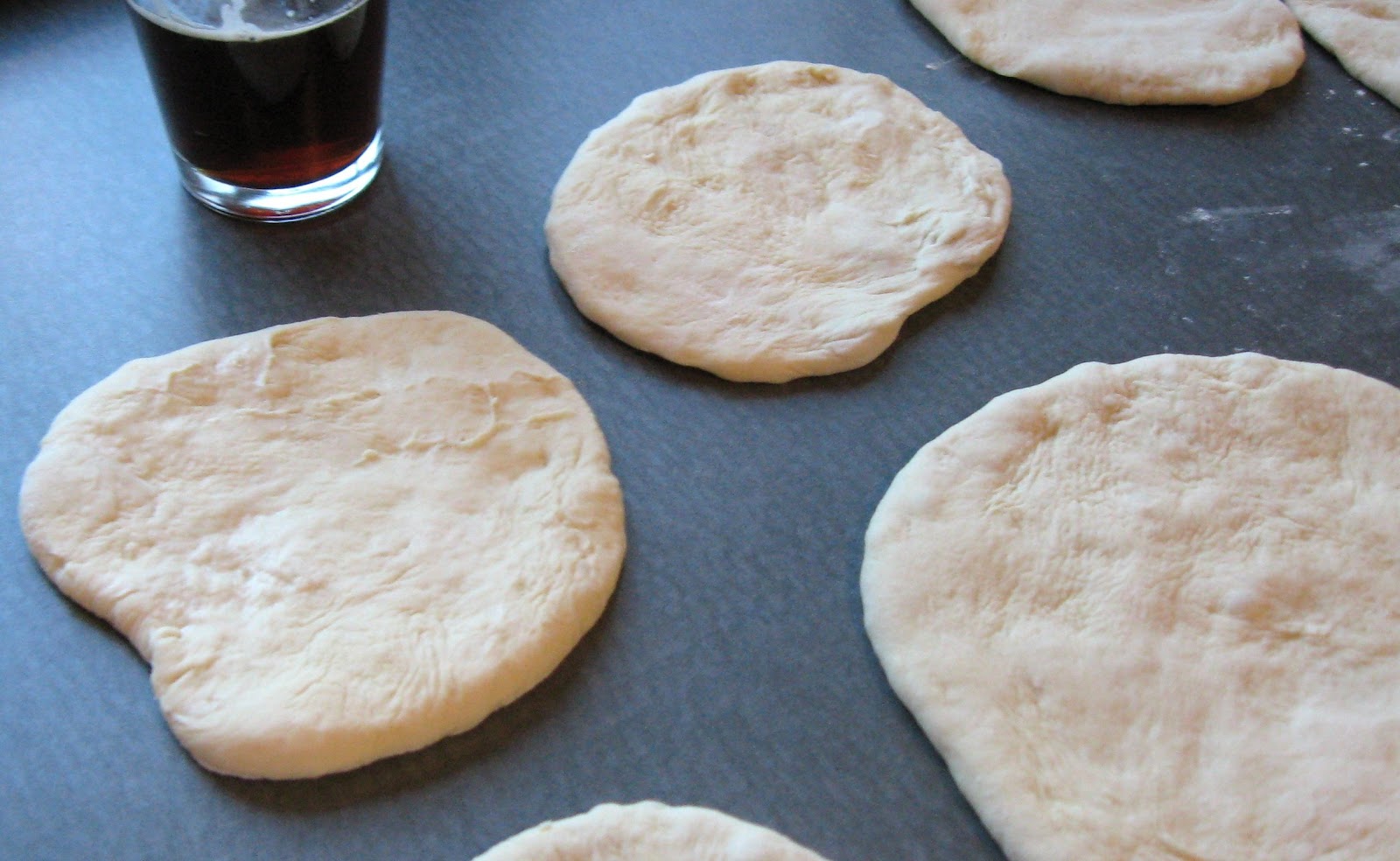
The dough was scaled to ca. 200 g pieces, squished into circles and allowed to rest about 10 minutes uncovered.

I baked them in a 500°F oven on a preheated baking sheet. The sheet was enamel on steel. A new favorite baking surface of mine.

11.16.2010

notes to self for pain au levain

x = 30 g

1. 1x(flour) + 2x(pineapple juice) + 2d ---> 3x[A]

2. 3x[A] + 1x(pineapple juice) + 1x(flour) + 1-2 d ---> 5x[B] see image

3. 5x[B] + 1x(water) + 2x(flour) + 1-2 d ---> 8x[C] see image

4. 4x[C] + 1x(water) + 3x(flour) + 1 d ---> 8x[D]

5. 4x[D] +9x(water) + 12x(flour) + 4-8 h ---> starter= [S]

>> [S] can be refreshed according to:
1x[S] + 2x(water) = 3x(flour) ---> 6x[S]

Pain au levain

3x[S] + 5x(water) + 8x(flour, mixed) + 6-8 h ---> levain

16x[levain] + 11x(water) + 16x(flour) + 1% w/w salt ---> dough

(a strategy to follow based on Reinhart's Artisan Breads Every Day (some rounding)

10.31.2010

Firedome: A new and easier fuel configuration, indirect - still a work in progress

Warning:  Long post (with water balloons)

What seemed correct with the Firedome to date was a symmetrically placed ring of fire about the cooking surface.  It's served me (and friends) well for over a year now, but a few lingering flaws forced me to persist in its development.

1. briquettes are good, but lots of byproducts and I could not boast "wood fired" to a more discerning crowd. I wanted to switch to wood. Something easier and cheaper to use and recharge on the fly without a mid-burn disassembly.
2. A wood fire would be hard to maintain in a circular configuration.
3. Any good pizza oven I've observed has the fuel source "indirect," not directly below the food, but in a pile offset.
4. I have a continuous stream of wood on my property.  Oaks give it up every time it's windy (remember Ike?).
5. One pile of fuel is trivial to start; a ring is often a pain.
All modifications must still result in uniform cooking top and bottom of the dough.

Today the wood fuel vision begins to come into focus; I think we might be hitting the oven that was intended in the first place.

A chilly morning seemed the perfect time for a fire and it's always a good time for lightly smoke-infused flatbread.  Made some dough, fired up a chimney of briquettes (briquettes are a killer starter for any fire by the way).  After  a few clumsy reorganizations, I placed the fuel on one side of the lower grate of the Firedome, placed the cooking surface on the upper grate and positioned the clay cooking surface on the opposite side of the grill.  On top of the briquettes, I placed several pieces of oak, they started immediately, a kick ass fire in minutes.  I capped the dome, lifted the door, positioning the opening so the blazing fire was on the right and the cooking surface to the left.

Here's how the morning progressed in a few frames and a few movies:

The circle of fire is ok, but laborious to maintain. Also!.. note the decorative chimnea stand I scored in someone's trash. Elegant? I think so.


This was shot after I moved everything to either side.  In this way, I could add to the fire by pitching wood right through the door as I need.  The flames would swoop around and I'd be cooking "in the tube" of the firewave.  It also tolerates water balloons tossed in when you need that extra bit of humidity.


Final product.  To be eaten with tonight's roasted red pepper hummus.
I'm waiting for a replacement thermocouple or this post would've been oozing with temp data.  However, a pita cooked in about 90 seconds.  I'm guessing the oven was about 750°F while the flames were up, maybe a bit higher.    There will definitely be more to come on this.

Final notes for those following along with your own pet Firedome:
1. one chimney full on one side of the lower grate
2. add small, ca. 8" logs of wood, on the briquettes
3. place upper grate in place with one side of the grate open in a way you can toss wood in
4. place Firedome on top of roaring fire with the hatch open, wait a few minutes and cook away
5. getting some wood this size might require a chainsaw
Enhanced by Zemanta

7.27.2010

Baba Ghanouj on the Firedome (and some additional notes on the continuing saga of the Firedome development)


I'm happy with the use of this thing, but I need more experience.  A big problem I'm having is dome temps.  They're all over the place.  It may not be a problem, it just has to do with whether there is a live fire or if the fuel is smoldering.  

The objective I set out to acheive at the beginning of this project was evenness of cooking, crucial for a pizza.  With this rig, the only thing that will burn the bottom of a pizza is placing the fuel beneath the stone and not on the perimeter.  I've observed this several times.  

What keeps tugging at me is using wood for fuel.  After briquettes are started, this thing is pretty damn hot and new fuel catches fast - and burns fast.  Also, since so much of the perimeter is accessible with the hinged grate, removing the dome, charging fuel and regaining temps isn't such a big deal.  I do it routinely.  Now, I want to try to recharge with two logs on either side.  Once they catch, I'm curious about the temperature and the burn time.  So, that experiment's on tap.  I also have a few friends queued up who need some samples for tolerating my babbling about this thing.