After reading Kashi's apple bake recipe using evaporated cane juice, I was so angry, I had to do about 5 consecutive sun salutations to manage my anger. Evaporated cane juice and plain old sugar are unequivocally the same, α-D-fructofuranosyl β-D-glucopyranoside (aka, sucrose, table sugar). After studying a while, the only difference in the processes used to isolate these substances on an industrial scale is one goes through one processing step more than the other. That's it. Same crop, same molecule. The white granulated sugar requires more energy to produce. So, it should be more expensive, tougher on resources and more expensive to produce. However, it costs less than evaporated cane juice, because people want what sounds "natural", regardless of the truth. Domino wins.
The subtle difference in composition between the two is simply the evaporated cane juice (ECJ) has a teeny bit more vitamin A, C and calcium (in a 100 grams sample). Take a vitamin. Lots cheaper.
In the industry, substances are produced according to specifications. Each batch produced is analyzed to insure compliance with the specifications. Documentation of this analysis comes in the form of a certificate of analysis (CoA). These are available to compliance agencies and geeks who really want to know weird information. I emailed DominoSugar.com today to try to get a typical CoA for granulated white and ECJ (their product name for ECJ is Demerara). They would not give up a CoA, but did give me the full nutritional specifications for each product. See below, and save your money.
| Attribute | evaporated cane juice, 100 g | granulated sugar, 100 g |
| calories, kcal | 400 | 400 |
| total lipid (fat), g | 0 | 0 |
| protein, g | 0 | 0 |
| fiber, g | 0 | 0 |
| calcium, mg | 18 | 1 |
| iron, mg | 0.0 | 0 |
| potassium, g | 0 | 2 |
| sodium, mg | 0 | 0.5 |
| vitamin C, mg | 4 | 0 |
| vitamin A, mg | 83 | 0 |
| thiamine, mg | 0 | 0 |
| riboflavin, mg | 0 | 0.019 |
| niacin, mg | 0 | 0.000 |
| price, 5 lbs., $ | 8-10 | 1-3 |
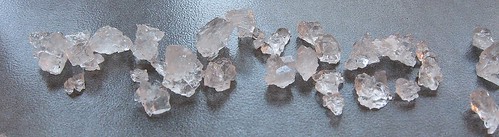
Some sugar Frankie and I recrystallized from water over a couple weeks.




 Posts
Posts


63 comments:
Evaporated cane juice is not filtered through burnt animal bones. :D
Demerara is not evaporated cane juice, it is boiled sugarcane. Evaporated cane juice is juice extracted from the sugar cane plant and then crystallized through evaporation. Most refineries use animal charcoal filters. Table sugar is usually processed with phosphoric acid, formic acid, sulphur dioxide, preservatives, flocculants, surfactants (lard is frequently used as a defoamer), bleaching agents, and viscosity modifiers.
1. Filtration usually occurs through activated carbon. Carbon. Pretty much the building block of life as we know it. The source of the activated carbon may be animal bones, it may be the bones of murdered loved ones, it's indistinguishably Carbon. It's likely MANY food and drugs you've come in contact with in your life have come in contact with ... gasp ... animal bones.
2. The other processing agents if they are used - and you don't know because most commodity manufacturers don't often shoot the breeze discussing their processing technology, aren't bad:
a. Phosphoric acid - it used to be in Coke, it might still be. It's everywhere, get over it.
b. formic acid - ants just love it and if it's concentrated and you squirt it in your eyes, it might sting.
c. sulfur dioxide - it's used to purge the microflora from wine prior to fermentation
d. preservatives - too broad a category, specify
e. flocculants - too many natural and benign ones to bother
f. surfactants - you mean like a detergent to clean the reactors with? Deadly indeed.
etc.
Sure, carbon is carbon, whether it's from animal bones or the bones of murdered loved ones. But if your loved ones were being systematically murdered for food, and then their bones used to whiten your sugar...
Mmmm, animal bones! Especially yummy in soup. And sugar? Nice white sugar in cherry pie... don't forget the lard in the crust.
I'm a proud member of "People Who Systematically Murder Tasty Animals And Eat Them And Then Use Their Bones To Make Sugar" (PWSMTAAETATUTBTMS).
"The other processing agents if they are used...aren't bad."
They sure as hell aren't good. Almost any toxic ingredient when sufficently diluted can be rendered non-toxic. Long term exposure is where the damage is done. Yes, these chemicals are used in most processed foods but when they can be avoided they should. There is a significant difference between processed table sugar and evaporated cane juice. If there was not, I'm sure DominoSugar.com would have provided the CoA you requested.
"there is a significant difference between processed table sugar and [processed] evaporated cane juice"
Yup, price.
Your statements are weak. If you want to keep going, have a spine, leave your name, and use some kind of data to support anything you're blabbering about. Or, go ahead and spend the extra money for the ECJ, you're worth it.
By the way, call any food company in the world and ask for a CoA on a batch of anything, they won't give it to you. I just tried for kicks. They're not public documents, they're turned over to regulatory agencies freely but there's simply no reason to give it to the public. Food producers don't try to poison people. Ethical considerations notwithstanding, they just won't make money if they hurt people.
"I live for your participation via comments - good or bad, anonymous or not - leave a comment and make my day."
Is your day made when you can use your readers as a punching bag?
Hmmm, got me. I do enjoy the comments.
Alright then, I don't care who you are, just give some valid support for the all-chemicals-are-bad thing. Any food product/nutritional supplement/drug, etc. has passed through chemical processing - even Boca Burgers. Most of it's harmless. There really isn't any corporate conspiracy regarding the purity of food products. Most of the harm is from marketing pushing claims that few people understand.
"Almost any toxic ingredient when sufficently diluted can be rendered non-toxic."
Um, right. And non-toxic means it can't hurt you. Similarly, any non-toxic substance when taken in large enough concentrations can be rendered toxic. Ever hear of water intoxication?
Just because a substance has a chemical name doesn't mean it's dangerous. Sodium chloride is made of chlorine! A deadly poisonous gas! Well, just try living without it. Dave is a chemist. I understand why he gets frustrated by such idiocy.
"Most of the harm is from marketing pushing claims that few people understand."
Dave, on that we can agree.
Hooray. Truce.
Thanks for your original post, Dave. I've been studying evaporated cane juice because it's showing up in a lot of products in the health food store & it sure sounds like sugar to me.
I'm sensitive to sugar, as well as white flour and other highly-processed foods. So I read the labels & i'm "mad as hell" about this particular deception.
Two things stand out in the world of sweeteners:
There are lots of web sites that are obviously paid for by marketers but not identified as such. Who else would push this fiction on the public?
The supression of stevia by the FDA as an accceptable sweetener in foods is criminal. between the sugar industry and the artificial sweetener industry, there's little space left for the truth to reach the public.
Sugar is sugar is sugar and for many people it's unhealthy & leads to weight gain & mood swings. Here's a good site to visit:
http://www.mcvitamins.com/Health%20Opponents/cane-juice.htm
"You are what you eat." Here is something to think about. You are whatever it ate also. And another to ponder; you are whatever your ancestry ate. Toxins build in the body. Then some of these toxins transfer to DNA. Ever hear, for example, that diabetes is inherited? Query, who did the first person inherit it from? If you do not believe that 1000's of today's ailments are not caused by the garbage we call "food", then you are probably in that group that still believes the Earth is flat. The statement about diluting toxins to the point they are safe is just stupid.
And for the record, I doubt that I will return here to read any responses but others may enjoy a rebuttal.
No rebuttal. The earth is flat.
Dave, you can't argue with someone who 'knows.' You just have to realize that if there's something to believe in, someone believes it. And they won't let it go.
Any way...
I loved this. 'Evaporated Cane Juice.' HA! My chemistry degree moans in pain when it hears stuff like that.
Oh, btw, I only use dried grapes. Raisins are just nasty. ;)
Thanks for the comment Erik. It's tough to convince the experts. Silly old formal education in an area isn't nearly as accurate as marketing propaganda.
Monavie
I'm sensitive to sugar, as well as white flour and other highly processed foods. So I read the labels & i'm "mad as hell" about this particular deception.
There really isn't any corporate conspiracy regarding the purity of food products. Most of the harm is from marketing pushing claims that few people understand.
Thank you for this! I've laughed every time I've walked through Trader Joe's and read "evaporated cane juice" on the label. I just thought it was a marketing technique - I never realized that people actually believed it to be *healthier* than plain ol' white sugar... To your body sugar is sugar is sugar, isn't it?
"sugar is sugar is sugar, isn't it?" Hi Anon. Almost. The difference is in metabolism. Demerera is metabolized identically to table sugar (sucrose). However, things like stevia extracts (4 monosaccharides attached to a terpenoid) is metabolized much differently. But, all forms of sucrose are pretty much sugar and sugar.
Actually non-toxic doesn't mean it won't hurt you, all it means is it won't kill you. By that i mean that it won't kill you immediately.
Should you regularly consume things you know to be harmful to the body in pure form when diluted down far enough? Your body still knows one way or another that you are consuming it, even if you want to argue differently. Why do you think America has SO many degenerative diseases compared to other cultures that have stuck to more wholesome, traditional foods? It's because of attitudes like that. It won't HURT me. So it's safe to eat. Shouldn't we be asking, "will it make me stronger? What will it ADD to my life?" here is the definition for non-toxic:
. nontoxic - safe to eat
non-poisonous, nonpoisonous
comestible, eatable, edible - suitable for use as food.
Rebecca, thanks for visiting but aside from looking up a definition, you didn't support one single item in your rambling comment. "America (north or south?) has SO (I guess that's alot) many degenerative diseases compared to other cultures (is America a culture?) that have stuck to more wholesome, traditional foods" What is a traditional wholesome food? French people eat brains, is this a better food?
Thanks for the definition.
Alright, inspite of your insulting behavior (not really sure why you would expect people to continue to visit your site if you're going to use such vulgar communication with them, but that's your prerogative if you don't know how to have an adult debate without lowering yourself to insensitive jabs) and aside from the fact that my comment wasn't directed toward you, and was in fact designed to be a general statement of how we should view our food intake i will support my argument.
To answer your questions: 1) North, plus England, and you can add to that the list of any of the countries that have now adopted the Western eating habits;
2) Cardiovascular, Atherosclerosis, Atherothrombosis, Osteoporosis, Diabetes, Cancers, Alzheimer's, Parkinsons, Huntingtons (although those would generally fall under neurodegenerative) , and the variants that fall under those larger disease categories(hypertension, stroke, congestive heart failure, congenetive heart failure, etc.) , so yes, Dave, you are right, there are quite a few;
3)North America has several cultures contained within, however, the eating habits generally fall under the cultural category of Western, so no, America is not a culture, but what we eat has a lot similarity across North America;
4) A wholesome food would be something that is in it's entirety, and in my personal definition, comes from Nature, not processed to smitherines, a traditional food is something that is preserved or eaten the way the ancestors have done so (i.e.; killing an animal and eating it on the spot, all parts included, or fermenting something such as Sour Kraut or culture for doughs or yoghurt, to create the digestive enzymes that help us so well in absorbing and breaking down the nutrients from the foods they are contained in, or not pasteurizing Milk and Butters, to preserve those same enzymes, especially if the animal is eating a diet full of dark green grass, because these are the more nutrient rich versions of these foods, also I think brains would be a fine choice for food, as they would have a complete amino acid profile and they are a high energy organ. High energy organs have been proven to provide us unique substances like CoQ10. From "The Power of Kaneka QH" by Dr. Robert Barry pg. 13 "Foods with the highest concentration of CoQ10 include dark, leafy green vegetables like broccoli and spinach, nuts, seafood, and meats, particularly organ meats: tissues with particularly high energy demands." Just because it sounds unappetizing doesn't mean it's not good for you. Mind you you would probably not want to consume it if there any risk that it had been infected by any form of a prion disease. You would want to know exactly where it came from and what it had been eating.
To further support what I am trying to promote here, I will direct you to a few researchers that have found non-conformative eating principles and have excellent studies to back them up. Their is the Price-Pottenger foundation. Pottenger has done a study on cats and what effects the cats have over the course of serveral generations of eating diets with particular deficiencies. It is documented how the cats degenerate over time with the impaired diet. It is called "Pottenger's Cats - a Study in nutrition" you can find the concise version here: http://www.ppnf.org/catalog/ppnf/PottengerResearch.htm.
Dr. Weston A price was a dentist who traveled from culture to culture, analyzing the diets, comparing them, and studying the effects the food had on the teeth and bone structure and also bone structures of future generations. He is also on that first website, however their is a Weston Price Foundation as well. Here is the concise version of his research: http://www.ppnf.org/catalog/ppnf/PriceResearchConclusions.htm or he has a book, or you can search this website: http://www.westonaprice.org/splash_2.htm - he has passed away and so has Pottenger I believe. Mary Enig and Sally Fallon also have several good studies with statistics supporting similar research on that website as well and have their own books. (Sally Fallon has a cookbook and it's really unique and useful. It tells you the advantages on the side of each page on the type of food you are making and the process that you make it with, and also the history of some of the foods) Another good source for looking at food as a way to enhance your life would be the research by Johnny Bowden in any of his books but I particularly like "150 of the Worlds Healthiest Foods", or you can read Bruce Fife's research on Coconut Oil and what effect it has on the human life, in any of his books, my favorite would be "The Coconut Oil Miracle". Another good source for the history of food and how it has become so far from what it actually started out to be and how that is causing disease is Michael Pollan's "The Omnivore's Dilemma". If you need me to support more of my argument, you can go to the website http://www.whfoods.com/foodstoc.php and pick any food on the site and do your own research. If I began reciting evidence for food being an enhancement to life, this would be a much longer post than it already is, (i.e.: a book) and I don't think you want that, because I bet you didn't even read this all the way to this point. What i'm saying is, there is plenty of research out there that goes to support wholesome, traditional foods as life enhancing and how not consuming them, yet consuming processed, chemically preserved mutated forms of what the food used to be has led people eating the Western Diet down the path to degerative disease.
You're welcome for the definition.
Oh and I should support my argument by also giving some more research on how going away from these foods has increased disease rates.
From "Coconut Cures" by Bruce Fife pg. 102, "In the coconut growing regions of southern India where large quantities of coconuts and coconut oil have traditionally been consumed an average 2.3 out of 1,000 people suffered from coronary heart disease in 1979. A campaign against the use of coconut oil on the grounds that it was an "unhealthy" saturated fat and caused heart disease decreased coconut oil consumption during the 1980s. Processed vegetable oils and margarine replace it in household use. As a result, by 1993 the heart disease rate tripled." pg. 104 " Studies show that in populations where Western food intake is negligible and coconut consumption is high, stroke and heart disease are absent or rare. Over the years ti has been seen that when island populations abandon their native diets rich in coconut and embrace modern foods and lifestyles, they develop the same types of diseases seen in the West and heart disease rates rise. The more Westernized the people become, the more their disease mimic those commonly found in the West.
Ian Prior, M.D., a cardiologist and director of the epidemiology unit at the Wellington Hospital in New Zealand, says this pattern has been very clearly demonstrated with Pacific Islanders. "The more an Islander takes on the ways of the West, the more prone he is to succumb to our degenerative diseases." He states that the further the Pacific natives move away from the diet of their ancestors " the closer they come to gout, diabetes, atherosclerosis, obesity, and hypertension.""
And I wanted to add that I was originally reading this for the sugar comparison aspect, and I can't pinpoint where I read it from right at this moment, because, well it is 2:21 am, but I do remember reading that evaporated cane juice has many more nutrients in it than white sugar (similar to those found in molasses) and has a lower glycemic index (mind you, not much lower). I don't suppose I'd get any positive response to that, but in your research, Dave, have you ever come across that finding?
Rebecca,
This post is nothing more than a simple, yet analytical comparison of sugar derived from two similar processing methods justified by public domain factual knowledge.
Obsessively commenting into the early morning hours isn't a good sign.
A comment section of a blog post is a waste of energy to effect change. You should direct your passion and energy to a public health and/or policy program and try to implement healthy alternatives to America's deadly diet.
I know, but most people won't listen, they just laugh and call you a health nut, then die of a heart attack years later. I know that this post is a comparison, that's why i was asking, since you seem to be very well versed in the differences, although your body has the same reaction to ecj as it does pure table sugar, doesn't ecj still have more nutrients, because of the high molasses content? (Is it not the boiling off and evaporating of the external coating of the sugarcane crystals-- very similar to molasses?)
As the sugar passes through successive refining processes, recrystallization, it loses color (early on, it's like molasses, right) and eventually it's stripped of its nutrients, but the super white and refined stuff is essentially the same as the tan-colored Demerera. The big problem with the industry that sells this stuff is charging more for the product that is processed less. Otherwise, both things are just sugar, not so harmful.
The only reason some are mean to "health food nuts" (me included unfortuanately, I try to curb myself, apologies) are the arguments often come from anecdotal and not more valid sources. I looked at the sources on ppnf.org and wasn't able to see a journal name that was a peer reviewed journal.
Shooting important information into the public domain needs to come from research that gets evaluated by one's peers. You should definitely study policy or public health to convince others of your arguments.
where does brown rice syrup fall into this debate and what is a good source for gullible suckers like me to learn the reality of this stuff? thanks for the dose of info and sarcasm. ;)
FACT: all forms of sugar and grain products consumed in excessive amounts are immunosuppressive, including (but not limited to) fruits, grains, starchy vegetables, wild, raw, unfiltered, honey and cane sugar. Although, eaten in moderation and in whole, unrefined form, they're perfectly harmless (especially after a protein-rich meal)
If you want the whole truth and nothing but the truth regarding nutrition or alternative health issues and concerns then I strongly urge you to visit the most popular and comprehensive website on the subject matter:
http://www.mercola.com/
You'll find the answers to most of the questions you may have about the various forms of sugar and it's effect on your health in there.
It's certainly bad for business to poison people out right, but it's naive to think that the possibility of doing your consumers moderate long term harm weighs significantly against short term profit considerations. Besides, people are like Doritos...they'll make more.
And while there may not be any corporate conspiracy regarding the purity of food products, the reality of the economics certainly does not promote "purity" (not my choice of words, but I'll take it as intended to signify wholesomeness and general greater healthiness). I'm not a believer in conspiracies, however the natural alignment of self-interest often produces the equivalent effect. Don't expect cheap to come without costs, as maximizing cheap necessarily subordinates other considerations, among which are health concerns, environmental concerns, labor concerns, etc.
There are good reasons to vaguely prefer foods that are less processed or refined. The hard specific data on each specific case is indeed hard to come by, but there have been numerous cases where ingredients introduced by industrial large scale food processing have proven bad for our health in the amounts we consume over time, but only after they have been used for decades. The health effects of processes and ingredients that have been used for centuries are relatively better established. Frankly I don't have time to research all of the odd things that they may be introducing into my food (have a look here, for example, http://www.qemi.com/html/sugar.htm), and avoiding exposure to all such stuff as a default behavior seems a smart policy regardless of the higher food prices. Frankly I don't think "harmless until proven guilty" is a good policy for food ingredients or food processing chemicals.
Finally there are environmental reasons for choosing less processed products. Less processed tends to correspond to less pollutants, and lower carbon footprint. This is definitely true in the case of sugar refining. Sugar growing (regardless of refining) probably has an even greater environmental cost than the refining, so buying organic sugar is even more important in my opinion. Using less sugar is an even better way of reducing that cost, but well, we're only human.
Love this entire conversation!!
In truth, i do not believe much of the obsession regarding food.
We live longer and have healthier lives becasue of CLEAN WATER and SANITATION and MEDICINE
If less processed food would result in longer life, better health etc, etc, etc; why was this not the case before the 20th century?
We are blessed in the West with food choices beyond the imaginings of most billions and billions who ever lived.
I am sorry I do not know how to use these name/address possibilities....but my name is Diane
Thanks to the author of this blog. As I perused the labels at the local Whole Foods, I felt like natural foods companies were trying to pull a fast one on me by putting "evaporated cane juice" instead of "sugar." I was right! Unfortunately, that means I can't eat anything at all... I guess I'll have another plate of grass, please.
@anon (most recent anon), Some of the nocal sweeteners look fascinating. Natural and all that, e.g., Truvia, the first brand name formulation derived from stevia? I'm going to give it a shot soon.
~comes in late
I found your blog when searching for... guess. :) lol Because, just looking at the phrase "evaporated cane juice" made me think "oh, sugar? wtf."
People obsess over food. It's crazy, I think. No one (well, very few apparently) knows/remembers/understands "moderation".
Thanks for a li'l sane voice in the crazy crazy wilderness! xx
P.S. If formic acid is used in sugar production, how is it they haven't found a way to market that to the gestating community? (It is commonly found in prenatal vitamins)
~runs off giggling :)
Ok im tired of people saying "charred animal bones" or dead animal parts or animal bones in general.... the correct term is exoskeleton. it comes from a beatle and it is used in numerous other applications for filtering. All those wonderful flavors that people enjoy that are in nearly every food processed? you got it! they were filtered using this product. they called diatamacious earth and celatom. its ome of those common knowledge things that are known to anybody that works in the food industry and to the consumers it scares the crap out of them. But does that stop them from buying the products? NOPE! if it did then there would be alot of companies going out of business and people would be cooking more at home and actually using their kitchens instead of running to the grocery store all in the name of "convience"
Dave, you are very condescending. I came across your post through a web search. Liked what I read, but you are a jerk to some of the posters. You ask for facts, then you insult them when they provide them, saying they shouldn't stay up late or copy from other posts. Be nice, and more people will benefit from your findings.
guy-
I think that was in defense to my post. Thanks.
Just as an aside, white sugar is never bleached. The natural colour of the sugar crystal is white, everything else is just molasses.
The molasses is spun out of the sugar solution in a centrifuge, by purely mechanical means. No chemical "bleaching" takes place, ever.
"Then some of these toxins transfer to DNA. Ever hear, for example, that diabetes is inherited? "
They don't teach genetics in school anymore, huh? For those out there who are really passionate about nutrition, you may want to take a basic, college-level course in biochemistry before you begin your proselytization because you guys are spewing some wack stuff on this blog.
NO difference? Hers's the differnce: In summary here are ways that refined sugar can affect your health: o Sugar can suppress the immune system. o Sugar can upset the body's mineral balance. o Sugar can contribute to hyperactivity, anxiety, depression, concentration difficulties, and crankiness in children. o Sugar can produce a significant rise in triglycerides. o Sugar can cause drowsiness and decreased activity in children. o Sugar can reduce helpful high density cholesterol (HDLs). o Sugar can promote an elevation of harmful cholesterol (LDLs). o Sugar can cause hypoglycemia. o Sugar contributes to a weakened defense against bacterial infection. o Sugar can cause kidney damage. o Sugar can increase the risk of coronary heart disease. o Sugar may lead to chromium deficiency. o Sugar can cause copper deficiency. o Sugar interferes with absorption of calcium and magnesium. o Sugar can increase fasting levels of blood glucose. o Sugar can promote tooth decay. o Sugar can produce an acidic stomach. o Sugar can raise adrenaline levels in children. o Sugar can lead to periodontal disease. o Sugar can speed the aging process, causing wrinkles and grey hair. o Sugar can increase total cholesterol. o Sugar can contribute to weight gain and obesity. o High intake of sugar increases the risk of Crohn's disease and ulcerative colitis. o Sugar can contribute to diabetes. o Sugar can contribute to osteoporosis. o Sugar can cause a decrease in insulin sensitivity. o Sugar leads to decreased glucose tolerance. o Sugar can cause cardiovascular disease. o Sugar can increase systolic blood pressure. o Sugar causes food allergies. o Sugar can cause free radical formation in the bloodstream. o Sugar can cause toxemia during pregnancy. o Sugar can contribute to eczema in children. o Sugar can overstress the pancreas, causing damage. o Sugar can cause atherosclerosis. o Sugar can compromise the lining of the capillaries. o Sugar can cause liver cells to divide, increasing the size of the liver. o Sugar can increase the amount of fat in the liver. o Sugar can increase kidney size and produce pathological changes in the kidney. o Sugar can cause depression. o Sugar can increase the body's fluid retention. o Sugar can cause hormonal imbalance. o Sugar can cause hypertension. o Sugar can cause headaches, including migraines. o Sugar can cause an increase in delat, alpha and theta brain waves, which can alter the mind's ability to think clearly. o Sugar can increase blood platelet adhesiveness which increases risk of blood clots and strokes. o Sugar can increase insulin responses in those consuming high-sugar diets compared to low sugar diets. o Sugar increases bacterial fermentation in the colon.
"A comment section of a blog post is a waste of energy to effect change"
I'm impressed that just one person defended Rebecca. I came across this website because I wanted to know about the difference between sugar and cane juice. I need to said that it is a good info for common persons like me that are trying to understand processed, whole food pros and cons. But I think it is completely insulting to me and specially to Rebeca to said that is a waste of time, I actually think a learn a lot of new websites and books that are a good source for my hunting into the truth of food....so for that Thanks a lot to Rebecca and anyone here that had tried to bring a point.
Mindy! Thank you very much that was a nice complement in the middle of my day! I actually have taken a bit of advice though, and tried to apply my beleifs to a public perspective....i've written a lot of letters to congress, though email subscriptions i get about food and water watch, like trying to prevent cloning of alfalfa and trying to prevent the mandate on pasteurizign milk, which will, in essence kill everything good there is in milk if you get it from a good source to begin with! It makes me sad, because we do these things to ourselves, our own country and it is all in the name of money. At least having an opinion and using it feels like i am doing something about it. Again thanks for the nice complement, i appreciate helping in anyway i can!
Here's what I know. I ate my Kashi cereal this morning and couldn't figure out why I was so hungry within 30 minutes or so. I work hard not to eat sugar.
I thought it was absent sugar. I read the label and the 3rd ingredient was evaporated cane sugar. I've been researching it on the internet and here's my conclusion.
My body responded to it in exactly the same way it responds to sugar. Kashi, I don't trust you anymore. Lynn
Just reading through and aside from the very interesting article and commentary (the impact of which would have been greater without Dave's snarkish bullying...), I have to make a slightly off-topic note/correction on Deb's statement, that formic acid "is commonly found in prenatal vitamins". Formic acid is not found in prenatal vitamins. I'll venture that she either meant FOLIC acid and just erred, or actually meant formic, and is just misinformed.
~runs off rolling eyes...
This is so amazing to hear different people with different beliefs about ill health and great health. Try a simple experiment then you will know the truth. I know because I have been thru this experiment. Spend thirty days straight eating only cooked processed foods at every meal and write down how you feel and maybe you can go get checked out by a doctor to see what is going on inside your body. Then go on a thirty day raw fruit, and raw dark green diet including avacados daily for fat intake and eating mostly greens at each meal, then go back to the doctor and see the results. It will amaze you, it did me that is why I continue to eat this way every day. I am 51 years old with the metabolic age of 16. my parents have degenerated diseases and mine are gone. I don't need fancy words or complicated studies to prove what I experience everyday. I also don't need college grads with phds to try to convince me that I don't know anything. My personal experience speaks for itself. I am living proof that what you are is what you eat. Thank You
I'm loving this conversation! Lots of good points out there. However, my favorite is Patrick's. Although it doesn't clear up the "ECJ vs table sugar" quandry, it makes a great argument supporting those who say that heavily processed foods aren't good for you. You don't need science to tell you that you feel MUCH better when you limit your intake of processed foods. I can testify to that!
WOW! So many misinformed people out there. I have a phd in Nutritional Science, and am graduating from med school this May! This blog, along with the comments, is laughable! I could ramble on about specifics; but I'll keep it short. Rebecca, and Patrick seem to be the most intune with the truth. I can't get over one of the comments that I read. I don't remember who posted it, but something to the effect:
"It's phosphoric acid, it's in COKE! Get over it"
This was the most amusing to me by far! Coke! All of these years of studying nutrition, soda in general, is one of the first things we tell our patients to abandon.
It's not about the difference in product. It's about what is being unnecessarily added to the product. A few rule of thumb's to be followed are below.
1. The least proccessed your food is; the better.
2. Yes, it is true! Diabetes, and other diseases, can get coppied into DNA strands. We are what we eat. That's how our bodies function. Just a bunch of protiens, minerals, and molecules.
3. Feed for what you need. Meaning, we eat for energy. Don't give your body unnecessary foods. You're just making things harder on your self.
@anon thanks, finally truth in a sea of confusion. I'm a phd too in organic chemistry, that and a buck fifty will get you a tall at Starbucks. The post is about the processing of one sugar vs another. The outcomes, substantiated by the nutritional specifications indicate they're insignificantly different. The gist is a science-based consumer decision. I never said a thing about nutrition.
But, on behalf of myself and all the commenters, thanks for your enlightening and unsubstantiated contribution to the discussion.
yes thank you anonymous- the most informative and so very true content i love.
you should be an paid Health advocated for a better health organization somewhere- if you arent allready. (anon)
thanks again i really enjoyed the 0 sugar post- its crazy it could/should be called/ a drug? (refined sugar) or evaporated cane sugar.
to answer the main question-both essentially are the same, its just the obvious name thats not.
and yes big corporations are out to destroy you health- its a fact,
big tobacco just the first runner up! unfortionatly.
nice sharing dear I have also a great thing to share with you that is healthygreen.co/index.html
Healthy green provides the finest organic vitamins, Custom vitamins, condiments and organic dietary supplements.
They use all natural organic ingredients to create our products.
I’m so glad that I took the time to look at this blog, because let me tell you. Not a lot of people know how to balance knowledge of a subject and content Free Classified Ads.
Rebecca and Patrick are my favorite people in this discussion. Although dave is very informative in some aspects to. Thanks for the tips. God bless.
Your first sentence made me laugh so hard I reposted this article! I'm trying to clean up everything I eat. And in the spirit of the holidays, I thought I'd try some vegan chocolate chip cookies but had no idea where to get 'evaporated cane sugar.' lol. Classic. Reposted on fb.
I used to eat all manner of foods containing granulated sugar. Nowadays it does nothing but hurt my stomach whenever I eat anything that has white sugar. By experimenting with what I could and couldn't eat, I found that I could have evaporated cane juice without any pain. I'd like to know exactly why that would be if these two substances are "unequivocally the same".
Vegan?
Do you realize how many insect bodies that cocoa tree absorbed to be able to produce that chocolate? I guarantee that some of the same atoms previously present in living animals can now be found in your body! I only eat sunlight because it is the most pure form of energy and doesn't harm any other living things. I also make sure not to stand in front of any plants during the day, because I do not want to steal their sunlight by casting a shadow on them.
May you also be blessed by the Great JuJu up the mountain.
Thanks for the table! I was curious how much of a difference there was (I was assuming it was pretty small, because otherwise they'd probably taste rather different...), and it's cool to see the exact table. I've generally had it in Kashi cereal, because I'm not going to purchase it preferentially over regular sugar, but I like certain products that use it (partly because the products that use it often are more health conscious, so they don't over sweeten everything).
That said, I'd suspect that substituting mostly white sugar with a small amount of brown sugar would replicate the flavor better than using entirely white sugar.
If people really want less refined sugar (and don't want to chew on sugarcane, which is really quite tasty), jaggery is quite unrefined and available rather cheaply at ethnic grocery stores. It will certainly help improve people's health, because you really need a hammer to use it... You might find eating more sugar is then more hassle than it's worth. Of course, it actually does taste different from regular sugar. And sometimes it has some sand in it.
Evaporated Cane Jice has a lower glycemic profile. It takes longer to break down in your system. That is why it is recommended in diabetic recipes because it will not go straight to the blood stream and spike your blood sugar. Research more before you blog.
*Juice... spellcheck my post before I post :)
The difference in the glycemic profile between pure sucrose and other cane is virtually negligible, at least as far as a diabetic or reactive hypoglycemic would be concerned. Any doctor who recommends cane juice to a diabetic should be fired before murder/malpractice charges need to be filed!
Plus the glycemic index is a joke, the only simple sugar safe for diabetics on the scale is pure fructose...you know the same sugar that leads to high cholesterol and higher body fat retention
As far as chemical processing of table sugar.....the purification process is INCREDIBLY efficient, the trace amounts of any other chemicals but sucrose are lower than the level of impurities found in BOTTLED WATER!
I pay for evaporated cane juice (ECJ) at the store and put it in my pie while you pay less for white sugar and put that in your pie. I have the right to tell others I used ECJ evaporated cane juice--our pies may have the same sweetness, but I cared enough to use a less processed product and pay for it. That's life--grow up and dry your eyes!
All you babies want sweetness and not pay the price with calories--you can't have it both ways.
Post a Comment