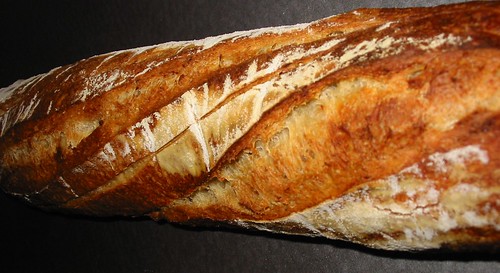
Every few months I take my starter out of the fridge, scrape off the mold, refresh it a few times and start a sourdough loaf. I usually never make a soudough baguette because of the logistical problem of how to do the final proof.
The final proof of a sourdough loaf needs a lot of time (usually retarded in a fridge overnight). If I use the baguette pan for the final proof, the dough embeds itself into the perforations and won't release when it cooks.
This time I let the final proof go in the fridge on top of a piece of parchment on a sheet pan, loosely covered with plastic for 24 hours. Then, without warming to ambient temp., I floured the loaf and flipped it into my baguette pan and cooked it @ 425-deg-F (convection) with a steam shot. Awesome.
The recipe I used was starter (thick, 150 grams), water (150 grams), flour (unbleached and some fresh milled from wheat berries (using a coffee mill, ca 75 grams wheat berries, 150 grams regular unbleached white). I let it rise for 2 days in the fridge. Punched down/20 minute rest. Final proof as mentioned above.
Can't wait to cut in!
12.08.2007
Baguette

10.01.2007
Merguez, Chickpeas and Swiss Chard
A while back, I found my best food find in Columbus. Mediterranean Food Imports carries merguez, a spicy (but, not too hot) Tunisian sausage. It's deep red and when sauteed, it renders some deep red colored fat. It tastes wonderful.
I started with about 1/3 to 1/2 pound of merguez sliced thin and sauteed in a high sided 6 qt pan. Once the sausage was cooked (about 7 minutes on medium), cleaned swiss chard leaves (a bunch, sliced in ribbons), a drained 15 oz can of chickpeas, a pinch of salt and ca. 1/4 C of water was added. The pan was covered and allowed to simmer on low for 10 minutes. In the meantime the couscous was prepared. After 10 minutes on low, the chard was cooked perfectly, wilted but not soggy. The mixture was served on top of a pile of couscous. It was absolute heaven!
Why no picture? None left. A welcome part of our dinner repertoire from now on.
9.29.2007
Farewell 'til next season
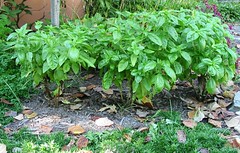 Few things in life are better than fresh basil. The leaves themselves are slightly bitter and oozing with juicy volatile goodness.
Every season, we plant a few seedlings, clip them as if they were a bonsai and end the season with spindly plants that flower and achieve low yields of the leaves we tried so hard to foster. This season was quite different. Instead of this "depression era mentality" of saving it all for the end, I started harvesting leaves as soon as they were available. From anywhere and not caring about the plant's future. I wanted the basil and I wasn't going to let them go to seed.
Interestingly, the more I tore off, the more they grew. In the beginning of the season (end of May, I started harvesting), I used scissors to get my fix. Then, as days got busier and dinner prep time grew shorter for one reason or another, I attacked the plant and just ripped off the leaves. And, they just kept growing - robustly. We now have 3 basil shrubs outside with more tasty leaves than we've ever had before. My friend Gary who's an extraordinary gardener, was amazed. He kept asking how carefully I harvested the leaves and I told him I just kind of attacked it. He was stunned. I am a total basil fanatic now and have grown a new appreciation of this robust herb. It'll kill me to see them wither on the first frost. But, next season, they're going in early and I'm tearing in quickly. Can't wait.
9.13.2007
Weber mod cold smoking action shots
Frankie and the mighty Mustangs will engage in their first soccer game ever (hopefully). In preparation, I'm fooling with the video camera and trying to figure out how to get a clip published on YouTube for the family and friends to view (clips can be private and email invites can be used for viewing). I only have Windows Movie Maker for editing. Not good but adequate to grab a clip from a stream.
One of my practice vids is some action shots of my smoker apparatus. It only took about two years of weekends to finish. And, it's not done yet. Today I'm smoking salmon. Really smoking - not cooking. Take a look.
And, here's my attempt at cedar, cold-smoked Salmon. Yum.
I also have plans to do my superfast, super good baguette. Stay tuned.
9.09.2007
Basil hydroponics?
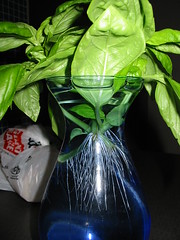 I clipped a small bunch of basil on my way in the house one weeknight and forgot what I was going to use it for so I stuffed it into some water to see if it would survive until I could use it. That was about 2 weeks ago! Now, I noticed it's thriving quite nicely. Click on the image for a bigger view. It's pretty awesome. I'm conisidering getting a perforated clear plastic piece to place over a pool of water to set up a mini hydroponic garden to see if I can use my basil for a chunk of the winter. It's my favorite herb and I LOVE to cook with it all the time. Keep you posted.
8.31.2007
Pulled Pork Tonight/Tomorrow
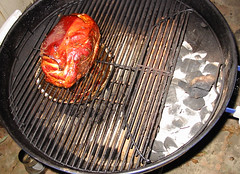 I've only tried barbecue overnight once and my heat died during the night. Tonight, after a great deal of reading my new favorite place to hang out, the forums on Virtual Weber Bullet, I found some modifications to a Weber grill to get me throuh the night easily. I made a bank of bricks to contain the coals and mesquite tidily against the side for a long burn indirect cooking of a sexy little 3.5 lb. picnic roast I picked up at Giant-Eagle today.
Tough to monitor in the early stages however. We've only been in this home less than a year and I just noticed the backyard is totally black at night. Kind of cool. I was only able to get this shot by pointing my camera in the dark and used the flash to see what was going on. This shot is about 2 hours into the cooking. Cracked about a 1/8 on the bottom vents and full open on the top.
I think I'll lose a bit of sleep tonight thinking about tomorrow night's meal. In the morning, I'll wrap it, put it in the fridge and take the kid on a wild day of activity. Tomorrow night, we feast.
"Hot meat, hot meat" Frankie will chant. Going to kill me if she becomes a vegetarian at 13.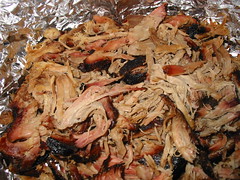 Damn, fire went out during the night because I didn't read the "Bullet Post" thoroughly enough. I was supposed to use the minion method to do the burn. Next time I guess. For now, I just fired it back up for a few more hours. When I found the grill out, the meat was still hot. Let it rip another few hours, wrapped it a couple hours and it pulled beautifully. It was a tad dry but really good. Frankie said "It's great Papa!". I don't get that too often, high praise indeed.
8.27.2007
Cold Smoking: Weber mod, v 2.0
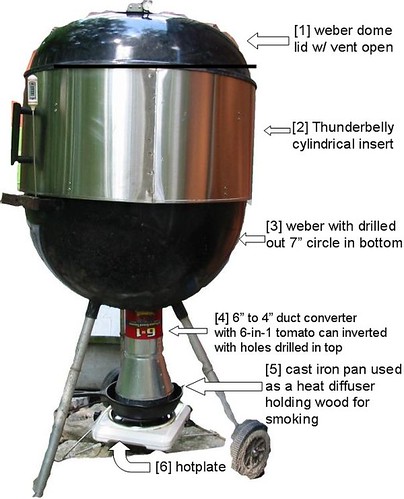
In my previous version of the Weber mod, I was essentially cooking, not smoking since my dome temperature was 150-deg-F. Since then I made the several changes. I'll point out all the features of the new version and indicate which are alterations to the old one.
1. Dome, no change here. Just a thermometer inserted to monitor the temperature near the food.
2. The Thunderbelly insert (caution: most horribly designed site in the world with loud music), used, as before, to position food further from the heat/smoke source.
3. The drilled out bottom to permit the smoke into the Weber kettle, no change.
4. The 6" to 4" ductpipe reducer. Perfect to fit an inverted 28 oz. can of tomatoes (empty, 6 in 1 brand). This is a big change. I drilled about 6 3/8" holes in the bottom of the can. This permits less smoke to go through the can as my previous much larger aperature. I believe this slows down the combustion of the wood resulting in:
a. reduction of billowing clouds of mesquite smoke all over the neighborhood,
b. my neighbors' comfort because they don't have to smell the billowing clouds of smoke all day,
c. our clothes and home won't smell of mesquite all day from the billowing clouds of smoke and,
d. the smoldering wood will last much longer (a ca. 2.5" cube smoldered about 6 hours).
5. Using my chimney/smoke conduit on top of a cast iron pan greatly reduced the dome temperature. The cast iron pan got really hot, but since the heat is essentially outside the system, it dissipates into the environment much better than the previous version. On a 80-deg-F day with no wind, I was able to keep the dome temperature at a steady 105-deg-F to 110-deg-F. Still on the high end of cold smoking, but on a cooler day, with a light breeze, this may be perfect for a 24 hour period of smoking, perfect for salmon or trout.
6. 650 W hotplate set on M, no change.
This was just a dry run with no food in the chamber. I have a couple more ideas to implement before a food run. Keep you posted.
8.12.2007
Best Feta in Columbus
Mediterranean Food Imports is my favorite ethnic market in the city. On the southwest corner of Dodridge and N. High the market has a wide variety of Mediterranean and Middle Eastern food not easily found anywhere else in the city. Over the past 5 years it's been through several owners and now it seems to be the best it's ever been.
Their best product is probably their feta. They carry Egyptian, Bulgarian, French and Greek styles. The Egyptian is probably their best seller; it's the mildest and creamiest of all the varieties.
My second favorite staple of theirs is their variety of grains and legumes. Lentils of all varieties and any mesh size of cracked wheat you can imagine. They even have Israeli couscous (sometimes called Maftoul, a larger mesh size couscous, awesome for this dish). And, now, bonus, a muslim butcher is on board. They have halal meats including Merguez sausage, a Tunesian sausage that's spicy and wonderful. I first experienced this delicacy at a Moroccan restaurant in Paris several years ago. It was heavenly. I've never seen it anywhere in Columbus.
They also have a huge variety of olives, olive oil, labne, dolmados, etc. If you haven't been there, you're missing out on one of Columubus' finest food gems.
ps An interesting recipe using merguez sausage.
8.05.2007
Not quite cold smoked salmon
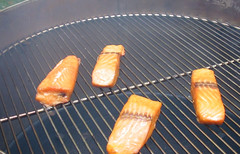 My cold smoker mod kind of shit the bed. Click on the photo to bring you to the Flickr slideshow of the project to this point.
The major problem is I ended up smoking at 150-deg-F. Hot smoking is at 225-deg-F and cold smoking should be at about 80-deg-F. Alton Brown smokes his salmon at 150 for 5 hours and I did too. But, I was shooting for several days at 80 degrees. I think I have to make the heat source even further removed from the smoking chamber.
I'll take what I have, let it rest and see what it tastes like. Maybe it'll be good enough. Keep you posted.
Notes 06-Aug-2007:
1. The fish was un-frickin'-believable. A tad dry, but I rushed the brining because Frankie demanded we go bowling (like, really fast).
2. The heat source is a bit of a problem and I'm working on switching to a food-quality liquid wax to heat the wood to smoldering (as I'm writing this, I have a dry run going). This is because the hotplate, while effective, smolders the wood too fast. A 3" cube of mesquite decomposed completely in about 3-4 hours. If I turn the hotplate down lower, it doesn't smolder at all. Also, the hotplate heats too much and the design wasn't effective enough at dissipating the heat. Maybe it'd work if it were 30-deg-F. But I want to smoke year 'round.
I want a near thermal-free smoke source.
3. Anyway, I have a pound of wonderfully smoky salmon that we'll enjoy tomorrow night on a bed of greens with warm lentils on the side and a sesame/soy/rice vinegar dressing. Yum. Not a bad first shot.
7.21.2007
Ramming Speed
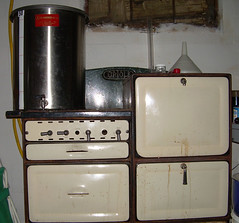 A couple weeks ago, I had another Father's Day! My wife entertained the kid while I brewed a soon-to-be-sampled batch of my English-style ale. I brew on a circa 1920's cast iron Oriole stove in a 50 liter stainless steel pot I bought from Italy. It's a nice combination of brew equipment.
The fermentation went swell starting at an original gravity of 1.052 and ending with a crisp 1.010 for an alcohol content about 5.5% by volume. I kegged it up, dropped about 20 psi CO2 on the headspace and I think it's almost ready for tasting. All that's needed is for the CO2 to finish dissolving into the brew and for clarification and it's finally ready. It's the maiden voyage brew in the new home.
If it tastes good, I'll be inviting some fellow food bloggers for a taste soon. Watch your email.
7.01.2007
Cold Smoking: The Heat Source
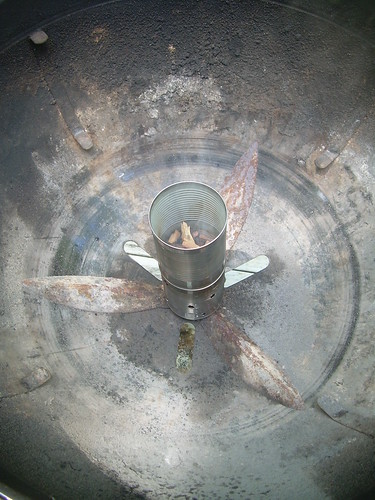 One requirement for cold smoking is a constant source of low heat to smolder wood. This is most commonly achieved using a hot plate and pan with wood chips in it. But, it's energy intensive and requires an outlet outside for the duration of smoking.
I wondered if a kerosene tealight (or paraffin) would do the trick. This could be placed inside a can (with ventilation holes) and on top of that can, wood chips in another can. I tried this using a citronella/kerosene tealight (I wouldn't use this in the future because of the citronella, but for proof of principle). The piggy-backed cans were placed inside my funky Weber-Kettle mod and voila! Within minutes, it was filled with mesquite smoke. And barely any heat generated. Since these little tealights can go for 12-18 hours, it should be a convenient source of fuel.
The big question, which will have to be tested on a piece of real food is: Does the food acquire any flavor from the burning kerosene? I suspect, since the kerosene is well contained in these tealights and if the combustion of it in the wick is complete, all the flavor should come from the choice of wood used for smoldering.
6.24.2007
Whole Grain Naan
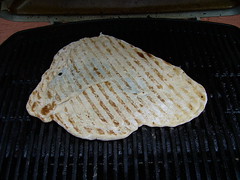 This Sunday on the way home from swimming, Trish asked if I could make some naan for the dish she was preparing (a special lamb and spinach Indian dish). When she says "naan" she's being generous. I make flatbreads that are closer to a pita than naan.
Well, not this time. I used a basic bread recipe and to cook, I chose my trusty Weber Q because it has a nice cast-iron grill surface. I heated it up to the highest I could, lubed up the grill with spray oil and plopped on my dough discs. They didn't puff up like my usual flatbreads (I usually do them in the oven). About 4 minutes per side gets nice small burn marks and the breads are heavenly. I only made 4 big ones. Here's the recipe I used:
Grainy Naan Dough
water, room temperature, 150 g
honey, 10 g/2 t
olive oil, 17 grams/1 T
yeast, rapid rise, 1 packet
salt, 5 g/1 t
swirl contents until honey's dissolved.
Add:
unbleached white flour, 150 grams
grainy flour (I used a 1:1:1 mixture of rye, wheat, spelt), 75 grams
Mix with large spoon until it balls up and then kneed briefly. Let rise an hour or so. Punch down and divide into 4 balls. Press the balls out to about an 8" disc using flour to keep them from getting sticky. Let rest and preheat the grill to the highest setting. Toss the dough on (I can fit about two on my grill at a time). Within a few minutes, they'll be sturdy enough to flip with a pair of tongs. Let cool and serve. Unbelievable.
feedback from the family:
There were 4 breads made from this batch. The thickest one tasted the best. The thinner ones were a little thin and cracker-like but the thicker one (depicted in the image above) was nice and floppy and tender.
6.23.2007
Weber Kettle Mod - Cold Smoking: Proof of Principle
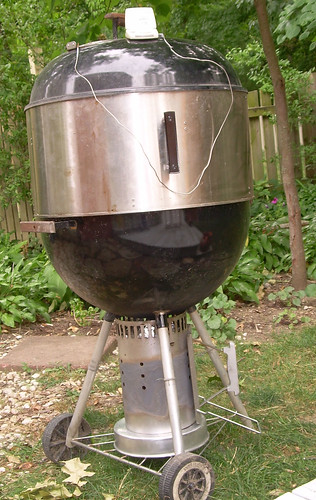 I have the itch to do some cold smoking. I'm especially looking forward to salmon and trout. Cold smoking is simple; it's simply a process of bathing food in smoke but in the temperature range of approximately 10 deg above ambient to not more than 110-deg-F for a long time (18-24 hours). Therein lies the challenge. Finding a cheap piece of equipment (because I'm frugal) that can maintain a constant low temperature for at least that long is no small trick.
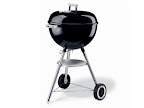
I took an old Weber Kettle I had from the trash and removed the bottom mechanism to permit the bottom vents to stay full open. I hypothesized if I could get the heat source below the kettle (rather than inside), I should be able to waft the smoke into the kettle keeping the temperature inside the kettle cool enough for smoking. In order to keep the cooking surface as far from the heat source as possible, I affixed a Thunderbelly stainless collar to my kettle (the cooking surface is on top of this collar). Then I used my starter chimney and built an 8 briquette fire in it, tossed in some mesquite shavings on top of the briquettes and shimmed it up close to the bottom of the kettle. In this configuration, the heat source is approximately half way in the chimney which serves to deliver the smoke to the bottom vents while most of the heat dissipates to the surroundings.
Monitoring the dome with a thermocouple inserted (with the vent full open), a temperature of approximately 95-105-deg-F (ambient temp 80-deg-F) was achieved for hours! Unfortunately, I could only hold this temperature for ca. 6 hours. Then, I'd have to charge more fuel and this would be annoying in the timeframe required for this process. Overcharging the chimney would likely result in too much heat generated.
This rig needs to be rock stable for at least 18 hours and since it's a long time, it also needs to be nearly maintenance free - I don't want to have to go out in my yard in the middle of the night (to fight a racoon).
In my next attempt, I'm going to use a hot plate and cast iron skillet to smoke wood pieces below the chimney. I'll still use the chimney as my smoke conduit.
A good first attempt, but I'm now waiting to find a hot plate at the thrift store. Keep you posted.
6.15.2007
Baba Ghanouj, an old friend.
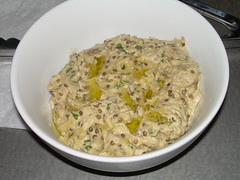 Ever make one of those meals that you immediately thought to yourself "why don't we have this more often?". Last night we wanted something simple and made one of our favorites Baba Ghanouj. It's so simple, healthy and we don't have it nearly as often as we should.
I took a medium/large eggplant and baked it on the gas grill until the shell was charred black (my wife started it actually). I took the charry eggplant and, with a potato masher, squashed it and pressed the flesh from it's charred body. The skin was pulled out of the bowl and to the bowl was added salt (1 t) the juice of a lemon, tahini (60 g, 1/4 C), some (nice quality) dried parsely, a couple tablespoons of olive oil and continued to mash away with my potato masher (an Egyptian woman I used to work with did it this way rather than a food processor to get a slightly chunkier texture). Depicted is the result. It was served with warmed pitas and fresh chopped veggies. A lovely Summer meal.


 Posts
Posts

