Recently, I decided to measure the volume of the first rise of bread dough containing various combinations of yeast, flour, shortening, etc. in order to see if this volume had any predictable relationship to favorable attributes in the final baked bread. I conducted the test on a small portion and called it an assay. The motivation was to try to gain some reproducibility in the final bread that has plagued my deceptively simple baguette. The volume measured was not predictive of the success of the final baked goods, but the method of measuring the volume of a small dough ball might still be useful.
The expression that titles this post is ubiquitous in bread baking texts. It's a way of telling a baker when to toss the risen dough into the oven, in other words, how long he should proof the final pre-cooked loaf. I don't know why the factor of 2 is significant, I'm guessing it was a more terse way to describe a complicated reaction; proof too long, the bread falls and is dense - under proof and the final loaf is equally ruined. This doubling factor is simply the optimal rise time to get the best oven spring without it flopping upon exposure to high heat.
"Doubled in volume" is not an intuitive end point observation on something shaped like a blob. Using what I learned on the volume measurements, one could take a small fraction of the dough, a small sacrificial piece, and measure its volume in a cylinder over time and use it as a type of indicator for the rest of the dough. In the video, we observe the full range of the lump of dough over time in a narrow cylinder. It actually rises about 3 times its original volume. But, at the end of the rise, we see the curved surface of the dough leveling out, indicating the dough is coming to it's maximum volume. This end of the rise also indicates the point in which the entire mass will collapse with a minor tap. This was a lean dough composed of water 180g, unbleached white flour 300g, yeast Fleischmann's rapid rise 7g, salt 6g, canola oil 6g and from that 100 grams taken for the measurement.
I think it's an interesting diagnostic to run beside a rising loaf. This dough ball is a sample of the bigger loaf; if it rises in the same conditions, it should provide an indicator how long to proof regardless of whether your kitchen is hot or cold, etc. In this case, the loaf should be baked an hour into the rise.
ps Dear @Conagra, can I have a job?
11.16.2011
let rise until doubled in volume
11.07.2011
A cast iron oven example boule.

10.31.2011
couple petit baguettes from a starter
I hacked together a starter, a wild yeast culture worked up from Stutzman farms whole wheat and then shifted to mostly white starter over the past couple days. I tried it out by incorporating some into a simple dough last night, prepped the rolls this morning and I'm about to dig in ... pretty tasty. Definitely worth pursuing.

10.29.2011
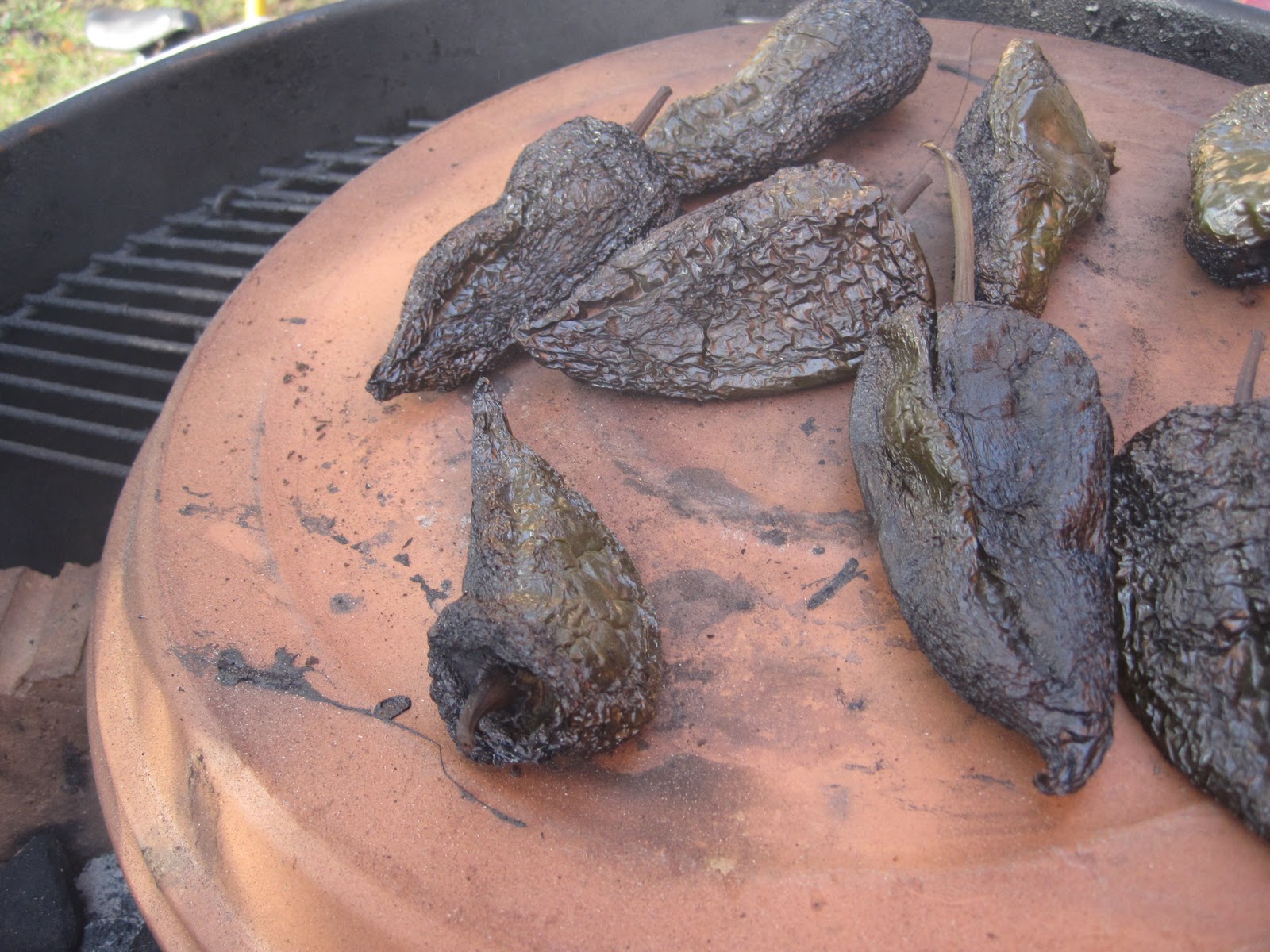
behold, the weber_cam (smoking poblanos real time)
Before...

After...
10.26.2011
Volume and little crispy boules that will eventually hold a meatball
Found a patent today I wanted to try to reproduce. The claim was a dough containing ascorbic acid, L-cysteine and xanthan gum produced a bigger volume bread than any single component. I've been trying little crispy boules because they're cute, they can be hollowed out to make a meatball slider and I can make a bunch of them quick if I want to feed the teachers.
Here's the comparison I did:
6 little crusty rolls on each side. These were made from 2 recipes varying only a few additives. Each roll started as a 40 gram ball.
Dough was made from
water 90 g, unbleached white flour 150 g, sugar 5 g, soybean oil 1% rel to flour, Red Star active dry yeast 3.5 g, salt 2.5 g.
-added to Left 6 rolls' dough:
vitamin C ca. 60 ppm
-added to Right 6 rolls' dough:
vitamin C ca. 60 ppm, L-cysteine 10 ppm, xanthan gum (all nat Bob's Red Mill) 400 ppm.
 |
| click image to enlarge, the difference is a little more clear |
The difference is tough to quantify (note: post baking weight average both sides 35 g). Finished bread volume is not trivial to measure, but the ones on the right look a little more full and they opened better at the slashed places. I'll let them cool until tomorrow and take a taste. While bread is warm, flaws are harder to catch, once cooled I can make some observations about taste, something to look forward to tomorrow.
Regarding parchment, on all but 1, I used a small disc in the bottom of the tin. It was plenty to prevent a blob from sticking. On the bread in the lower left corner, I used a cupcake liner and it stuck to the roll like glue. Those cupcake thingies are awful.
10.24.2011
dried apple chips
I've never been quite sure what is in those packages labeled "dried apples." This is what they look like when I make them - I do wish the images were better, but still tasty...


10.09.2011
I've been making some many tons of dough lately, working on my silly VFR100 assay, I've got nothing blogworthy, but this is good
I've posted this before, but it's so wonderful and it's so good that Scoopy didn't eat it before it went in the oven, just a lame old pork shoulder from Walmart popped in the oven last night at 225 for 8 hours. I had a little sugar, salt and pepper rub on it. Let it cool a while and pulled. It will supply at least a couple meals this week:
1. pork atop a bed of greens with asparagus on the side and bread
2. stuffed in tortillas
hooray pork!

10.02.2011
Some menu items for the week...
First of an occasional series. I thought I'd share a few of our weekday menu items. If lucky, I do some of the prep Sunday mornings:
 1 comments
Labels:
dinner,
menu,
veggies
1 comments
Labels:
dinner,
menu,
veggies
10.01.2011
VFR100 reworked assay
Another in a series of incredibly tedious posts guaranteed to scare away even the most dedicated of readers. To refresh your memory, this is to get an aggregate metric to characterize a combination of yeast, flour and any additive by the volume of the first rise. Once analyzed it will be applied to see if this volume (VFR100) is predictive of final baked bread attributes. See background of measurement in previous post. I reworked my assay a bit.
1. add:
-salt as a 10% w/w solution
-vitamin C as a 0.1 g / mL solution
-qs to volume, 90 mL
-yeast 1/2 t (assuming bulk solid density for yeast is constant)
-soy oil delivered by pipette
-flour 150 g
2. knead 10 minutes via machine
3. scale a 100 gram piece and round it
4. let rise in cylinders like these, tall narrow to elongate final reading for precision, coated on inside with floured oil spray so the maximum height is marked after maximum rise falls, e.g., see typical final rise volume in image below.
 |
| click image for close up, left two are fast rise yeast and right has an extra 100 ppt shot of vitamin C |
C = vitamin C
yeast (charged at 2%):
salt for these 250 total dough runs, 2.5 g
| fat (% v/w) | yeast | additive | V of 100 g rise (mL) |
|---|---|---|---|
0.0 soy
|
RedStar
|
0
|
262 261 260 258 260
|
2.0 soy
|
RedStar
|
0
|
308 313 263 280 301
|
2.0 soy
|
RedStar-f
|
0
|
255 275 278 280 301
|
2.0 soy
|
RedStar
|
C 1000 ppm
|
338 320 320 310 333
|
2.0 soy
|
Fleischmanns-f
|
0
|
275 280 274 275 295
|
2.0 soy
|
RedStar
|
C 2000 ppm
|
321 326 338 345 360
|
Preceding runs anova=> R results
Significant effects: -oil in the dough gives greater volume than no oil, consistent with literature for baked bread volume - may be worth evaluating more concentrations -Big vitamin C effect but not so much between 1000 and 2000 ppm -fast rise yeast bigger volume than active dry *Additional values added after anova tabulated below |
|||
2.0 soy
|
RedStar
|
C 1000 ppm, lecithin 1t
|
380
|
2.0 soy
|
Fleischmanns-f
|
lecithin, 1t
|
280
|
2.0 soy
|
Fleischmanns pizza
|
L-cysteine in yeast
|
296
|
4.0 soy
|
Ff
|
0
|
???
|
The sloppy discussion (by sloppy I mean I'll keep adding to it as I think about it)
1. The volume effects, despite the unbalanced design, reflect a lot of what's observed in the literature. A low concentration of oil in lean dough is well-documented to result in bigger volume loaves and this is what's observed in the dough as well.
2. One of the biggest effects is the vitamin C (ascorbic acid)* added to dough. Vit C addns. gave structurally sound, huge dough volume on rising. As far as concentration, I killed it, 1000 ppm is a lot more than the more conventional 50 ppm seen in the literature. However, I haven't yet found articles relating to the specific increases in volume of final baked breads as a function of vitamin C concentration. In my hands, breads made with 1000 ppm (100 mg vitamin C per 100 g flour) have consistently crappy oven spring, it's a real bummer of a result.
3. Point 2 is leading me to believe the VFR100 just isn't predictive of the things I'm looking for in a final loaf.
4. This assay, to do with enough replicate runs is laborious, all the practice I did was interesting and useful. I'm considering a way to make it a faster analysis. That way I could crank many more effects and be able to see parameter interactions. Maybe some pilot work and then take a look at reducing vitamin C/fat to try to figure out the interactions.
* Note: There are some who believe vitamin C and ascorbic acid are not the same. They are, atom for atom, stereocenter for stereocenter, etc. etc. identical in every single way.
9.05.2011
breadcrumbs
Obviously, there's no shortage of raw materials for breadcrumbs here. My need for breadcrumbs is primarily in the breading of smelts. I like the crumbs fine and uniform to give tenacious coating to the deep fried delicacies of the sea. Believe it or not, I usually buy my breadcrumbs because every method to make them sucks. I won't use the Cuisinart since it was designed to be irritating, 4 pieces that are difficult to clean isn't worth my time. Pounding the stale bread with a mallet is messy and often breaks the bag. Before going to the market to get some (Progresso), I tried this...

honest. I placed the crisp bread in a heavy plastic bag and made some use of the several ton piece of modern life in the driveway. I pushed the car back and forth over it about 5 times. Aside from a little fear that the neighbors would think I was insane, it was pretty easy. But, uneven particles. If they're not fine enough or uniform in size, the breading can fall apart in the fryer. Darn, another genius idea failed. I'm off to market.
9.03.2011
On the Development of a Predictive Metric for Bread Loaf Volume, the VFR100
It is generally recognized among food scientists that greater volume in a baked bread is associated with favorable properties like tenderness, desirable mouthfeel and reduced rate of staling.*
Personally I like bigger volumes in my breads and the pursuit of achieving that continues today for my white and wheat breads. Bigger volumes are most commonly obtained with a small fraction of fat, ca. 3% w/w percentage of the grain bill.* In addition to the oil, a functional ingredient, I have also noticed the brand and type of yeast have a significant impact on the dough (structure during rise, tackiness, rate of rise, etc.). Further complicating this is my unsubstantiated loyalty to a particular flour.
Evaluating the effect of various combinations of fat, yeast and flour on the final baked loaf is a daunting task. After the ingredients are mixed, many factors, e.g., the number of rises, the proof (final rise), docking, baking method, baking sheet, oven humidification method, etc. can have a significant effect on the results. In an attempt to support these preferences with something more quantitative, I'd like to find a reproducible and relatively fast assay for these ingredients that correlates with a final baked product.
My hypothesis: Given a selection of dough ingredients, the volume of the first rise will lead to a predictable outcome of the final baked loaf of bread, presumably the greater the volume of the first rise, the better the loaf. I'd like to stop at the first rise because I think it's the optimal point of intervention. All the ingredients are included and working. One serious potential flaw is there is no way to evaluate the effect of oven spring. This volume will be called Volume of First Rise of a 100 grams sample, the VFR100.
Method for obtaining the VFR100
The data collection phase will take a long time. I'll populate the table as results become available. Feel free to suggest additional parameters in the comments. I can't promise I'll include them in the testing, but I'd love the input.
data collection underway
Table Abbreviations
ap, all purpose
b, bulk
C, ascorbic acid
f, fast
F, Fleischmann's
GM, gold medal
MT, Montana Sapphire
RS, Red Star
ubw, unbleached white
* http://onlinelibrary.wiley.
9.02.2011
A DIY Uncrustable, Kid Lunch Edn.
Well, kids are back in school and I'm working to figure out new things for Frankie's lunch. Remember seeing those peanut butter and jelly pockets on tv called uncrustables? While discussing this odd food during dinner, I was wincing and Frankie was wriggling with delight over the thought of them. After I tried a version of my own...

using a ravioli press, some wheat bread and some intense muscle power with a rolling pin, I failed miserably. I made squashed bread with oozing fillings. It looked even worse than this picture by the time I finished.
Then, Frankie helped. I needed to "clamp down the side of the sandwich." Hmm. Here's how it went once she jumped in to help.


Each side of the sandwich was then reclamped thusly. Notice the complete absence of oozing.

8.17.2011
Richard Stephen, CEO of Weber, can I get a grant for working on this simulator?
(... or a new Easy Bake oven for pizza)
I have at least one lingering issue regarding my Firedome project: Does the intake of air from the bottom hemisphere matter? What happens to inside if I take air in...
a. through the bottom center?
b. through the sides?
c. both?
d. is there a swirly kind of convection of air going on?
e. can I get higher temps by optimizing this pattern of vents?
etc.
Instead of carving up a zillion bottom halves of grills, I figured it was time for a simulation vessel. I'll use tea lights initially for a heat source and measure temp differences with a thermocouple in the lid and try to use a smoke source (incense?) to visualize air flow patterns. Of course, if I didn't dislike reading so much and I could figure out the math, I might be able to make a more sophisticated hypothesis, but this is more fun. Also, there is a flat disc in the middle (cooking surface) that might screw up calculations, so here goes...
 |
| Bottom half drilled out bottom and side vents. It is also affixed with a lower grate that will hold the fuel source. |
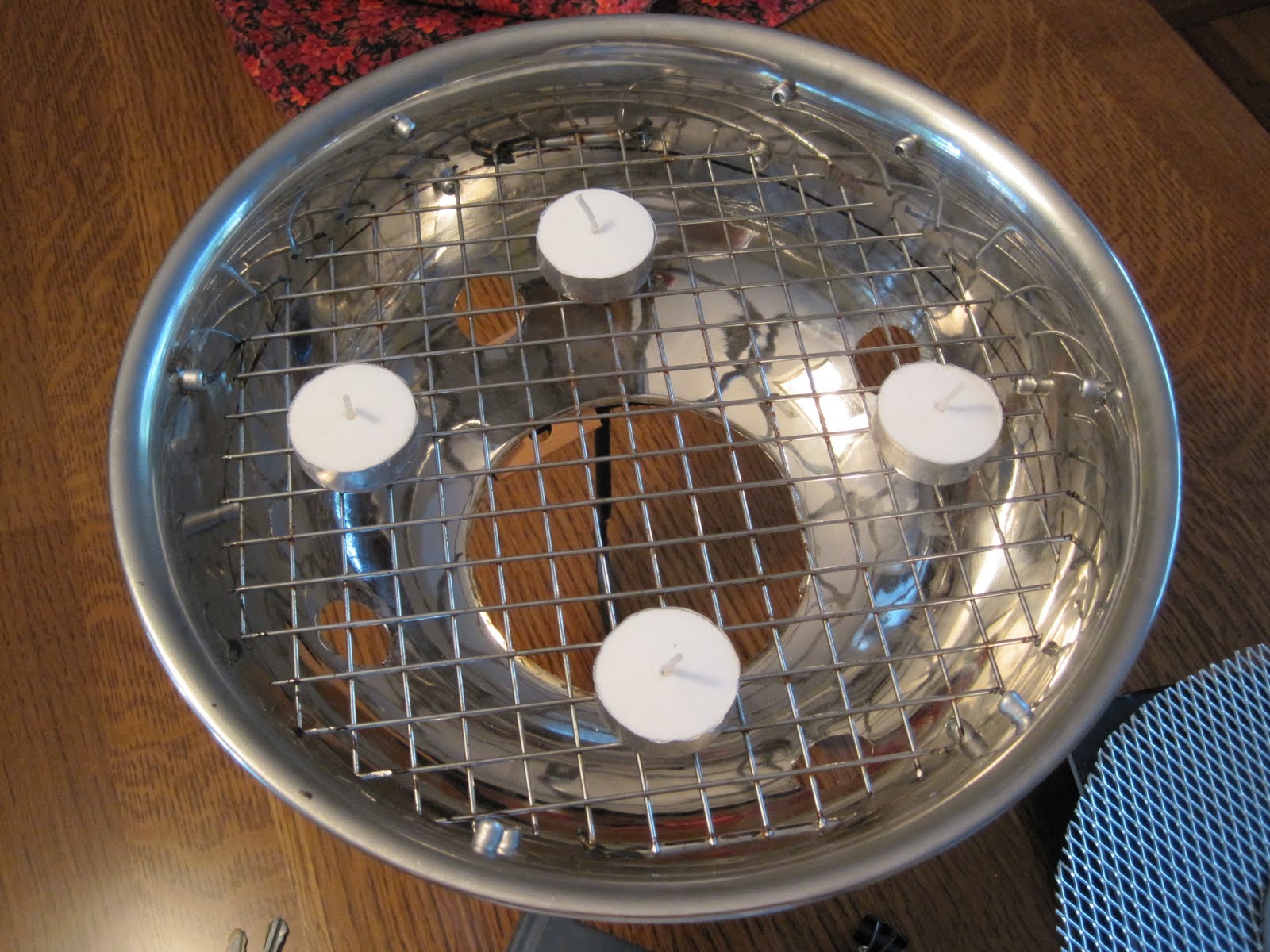 |
| Lower grate in the bottom half with tea lights, a proposed initial fuel source. |
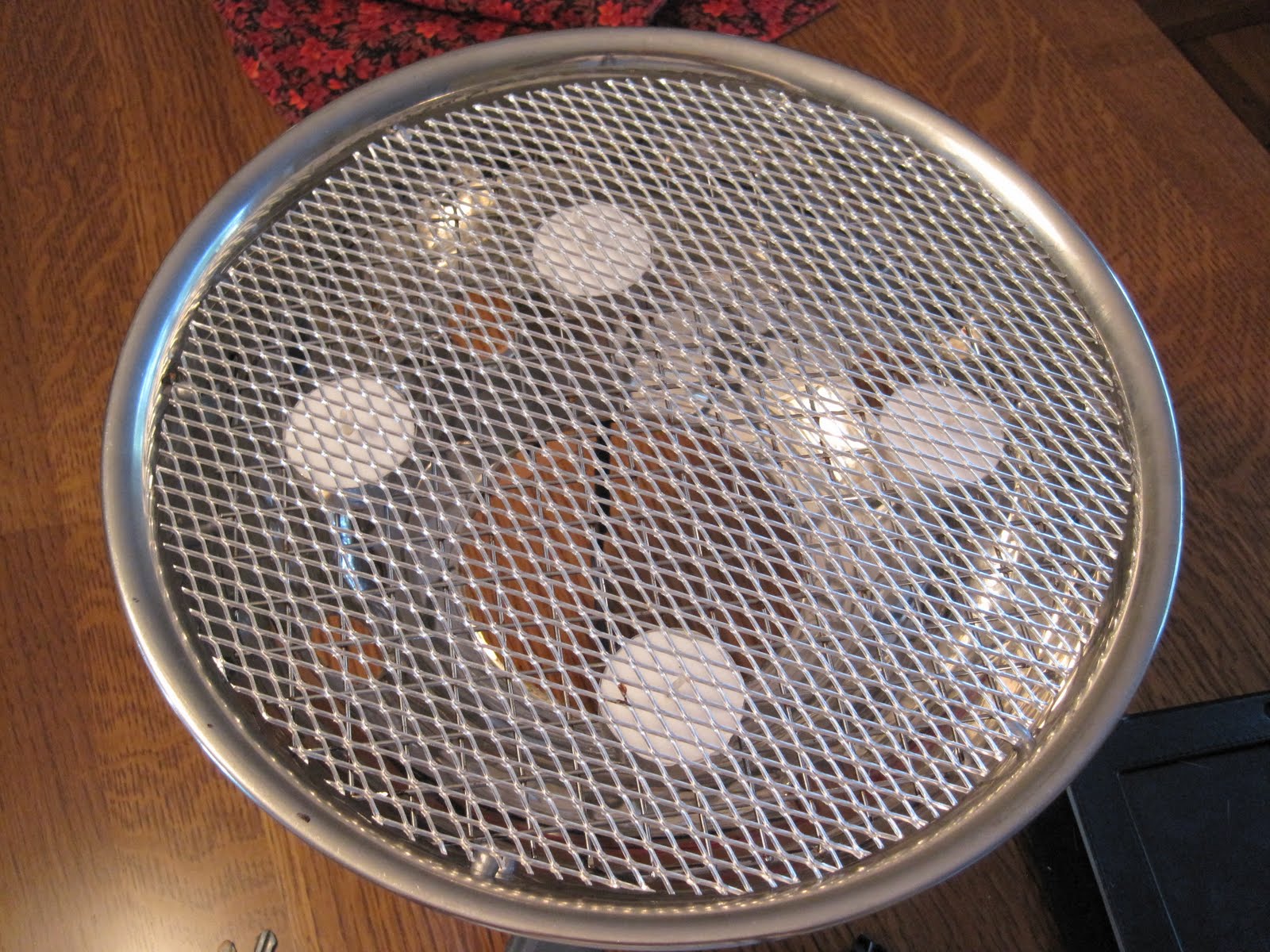 |
| The bottom half now equipped with the upper grate, or in the real grill this is the cooking surface. I need a teeny tiny clay surface for this. |
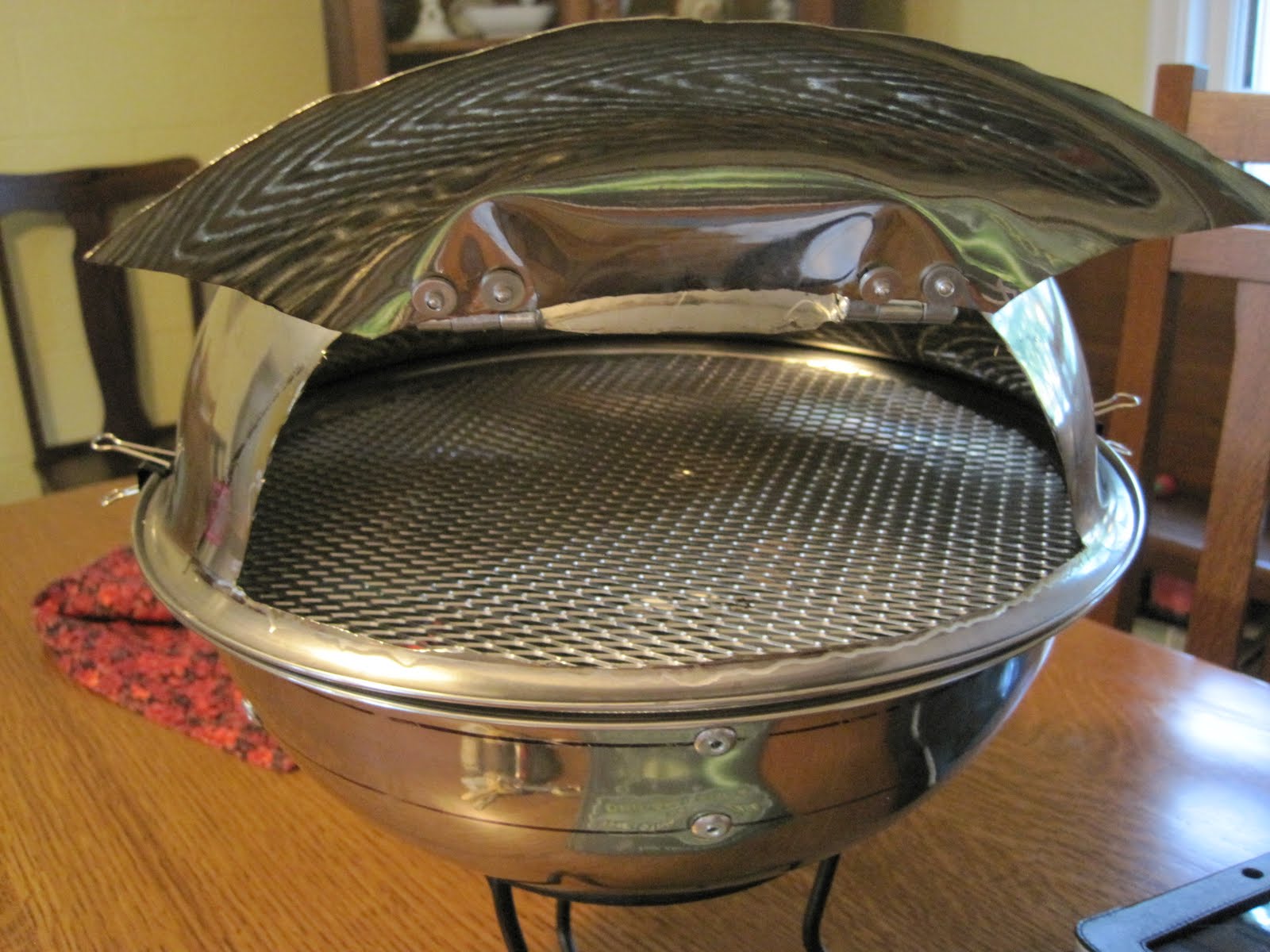 |
| The top half is affixed to the bottom with binder clips. The top half is a model of the Firedome with 1" hole vent in lid and the famous hinged door. |
 |
| Just an image of the chrome bad ass monster. The entire apparatus will be suspended in a stand above the "ground" using a plant stand. |
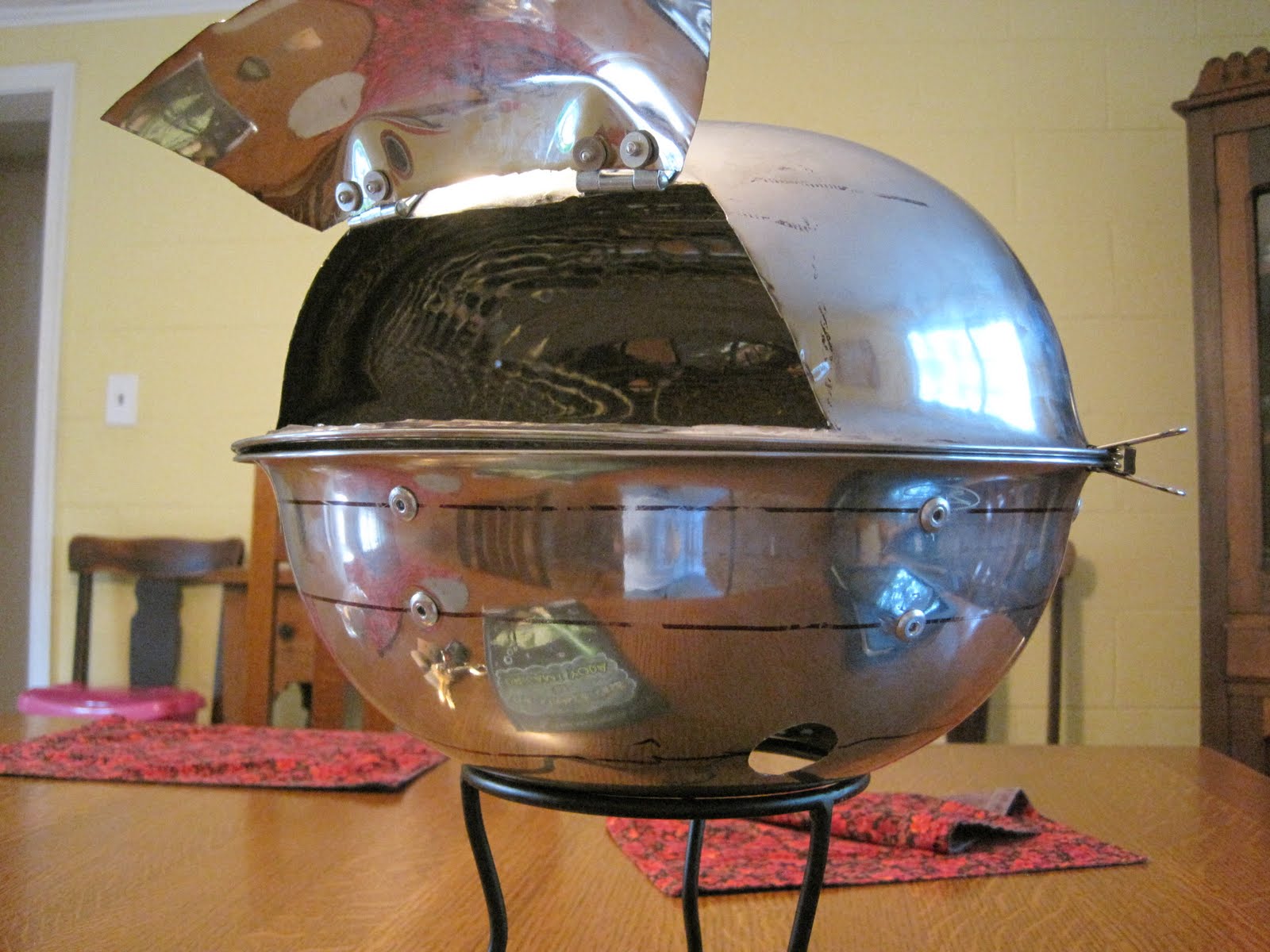 |
| The simulator sitting on a rack suspended so air can travel in through the bottom and side vents. |
Update: Not learning much, I really need a good voluminous smoke source. Incense isn't enough and it attracted hippies.
8.02.2011
Waafer thin pizza
4. The wife and kid like the thin pies too.
water, 220 g
unbleached white flour (Montana Sapphire), 300 g
sugar, 5 g
olive oil, 25 g
salt, 5 g
yeast, Red Star instant active, 7 g
Mixed, 1 rise, scaled to 150 g and rolled to 12" diameter (pretty exact)
topped with fresh thinly sliced tomato, chevre and basil, baked at 450°F

water, 180 g - all else the same
...stay tuned...


 Posts
Posts

