2.25.2012
Teeny weeny offset smoking box to cold smoke bacon. (Smoke Daddy smoker)
Thanks my love (finally used my xmas gift).
This rig was assembled from a standard 22 1/2" Weber kettle, a Thunderbelly stainless steel insert (don't even know the website for that anymore) and a SmokeDaddy (.com) cold smoking thingy. I smoked using some chips I had lying around (maybe mesquite?) for about 8 hrs. Ambient temp inside was low, only about 60°F. That little blue tube comes from an aquarium pump and blows smoke from the offset into the big chamber, it's all part of the SmokeDaddy.
See finished product.
2.20.2012
Chickpea flour (besan) noodles, the experiment (in images)
Given a kid's zeal for noodles, I wanted to try to fit some more nutrition in by using chickpea flour (ground chickpeas, purchased at Mediterranean Food Imports for the locals). Beans have a little higher protein and about the same carb count as flour, although the carbs must be more complex and better nutritionally. BUT, they lack gluten, so the extensibility of a final dough is in question at high levels of bean flour. I took an arbitrary stab at 50:50 besan:unbleached white flour.
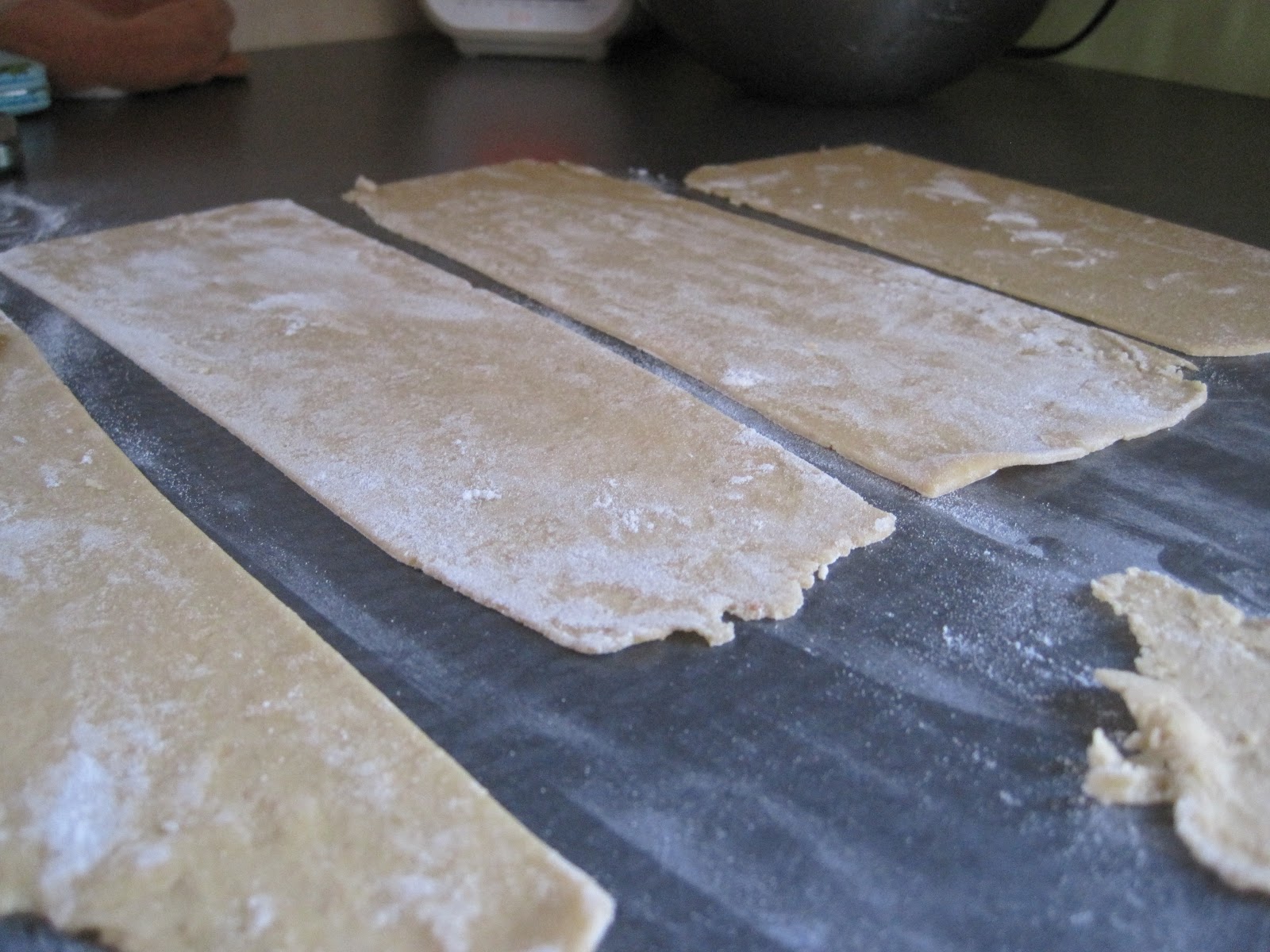
The lump of dough was broken into 4 pieces and I started sending it through rollers. Yup, much less gluten, lots of tearing, not much stretch. But I persisted and got to squish the dough down to a "4" setting, much thinner and it fell apart going through the rollers. Above is depicted the sheets. I let them dry out a bit before cutting into noodles, this keeps the noodles from sticking to each other.
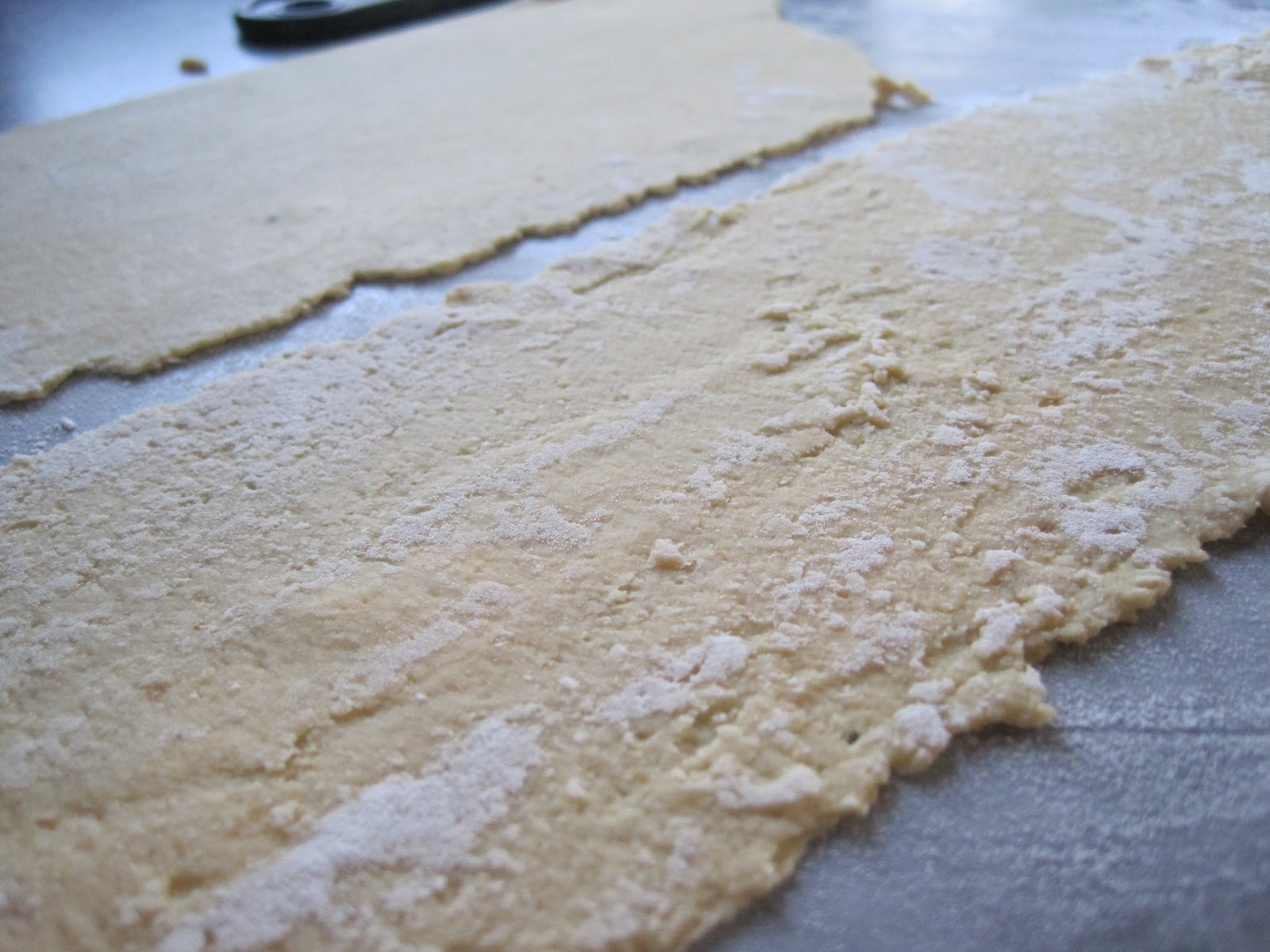
Here's a closer view of the surface of the dough after many passes through the rollers. With all flour, the dough becomes tough and smooth after this operation. In this case, the dough is always more fragile than with only flour (or flour and semolina).
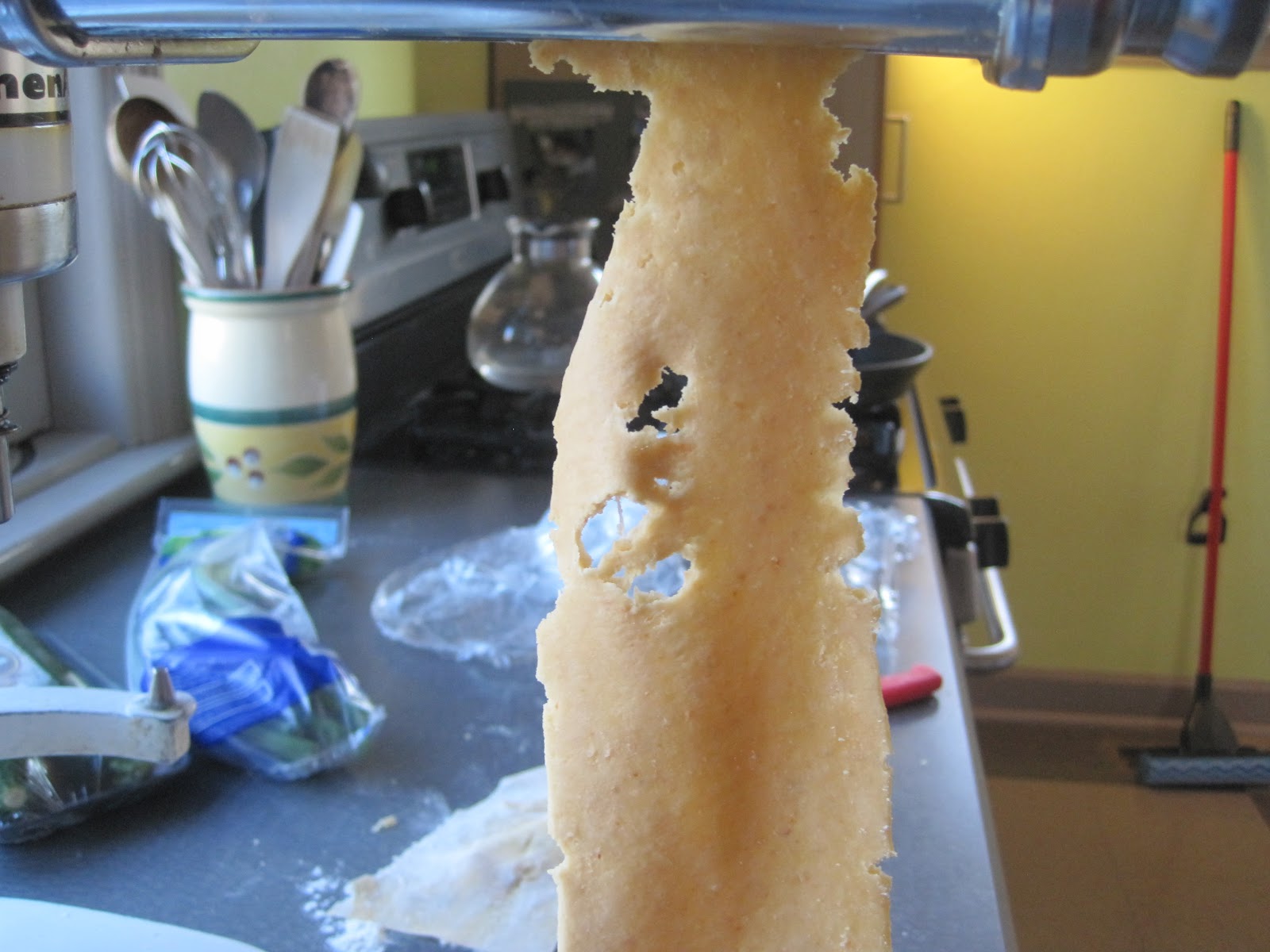
Here's what happens sometimes after a pass through the rollers. This gets folded and rerolled and eventually it comes out acceptable.
After my sheets rested and dried out a little, I trimmed them using only a pizza cutter. I like the wide uneven noodles.
How were they? They held up to boiling water just fine, they were tougher than I thought. I boiled them like any other pasta, in salty water and served them with butter, oil and cheese. They had an interesting flavor, very good I thought. Tough noodle to get right. Need a lot of patience and no way would I hand roll these things. I think I'd make them again.
2.11.2012
What a fun market, La Plaza Tapatia
This simple search for a product named yeast brought me back to Lyon, France 20 years ago, my first time out of the country on business. Me and my little cue cards struggled to communicate the simplest of words. Back to La Plaza, after 3 employees and finally a little kid hanging out by the meat counter, we realized the translation for yeast (levure) and I was set in the right direction.
I couldn't find the product, but I already hit a jackpot, I got to discover a community I never knew existed in my back yard. While there, I got a bunch of beans including these killer spiced, roasted lima beans (reminded me of my expt with cannelini).
1.29.2012
An unconventional method for making biscuits results in puff pastry, and we're glad about that.
A big motivation for this site is from the question "what's the recipe?" Few questions overwhelm me to point of being speechless. A recipe is a list of ingredients, to put them together is a bigger proposition. I used to go into the details, then I perceived the trapped person glazing over and I realized the person asking was simply trying to give a compliment but wasn't really interested in the preparation. The website was an easy way to get off the hook. I could point them to the site and details.
It's Sunday and that's often a morning of biscuits and fruit. My typical biscuit prep is 300 g flour, 2 teaspoons baking powder, salt, a T sugar, cut in butter (100 g) and moisten with 180 grams liquid (water or milk), mix, fold a few times, cut in circles, bake at 450.
Today, since I was in croissant mode, I took a different tack with the same biscuit ingredients and stumbled on something nice. I made a dough mixed from water (90 g), flour (150 g), salt (3 g), sugar (1T) and baking powder (2t) - which could just have easily been made from self rise flour (150 g) and water (90 g). That was kneeded in a bread machine while I made a 55 gram butter pat in a small ziploc bag using my butter trick. The dough and butter were treated just as in the croissant method (albeit much smaller rectangles, but still 81 layers) and cut into squares.
It was a lean dough, leavened with just baking powder. Butter was then added, and the folding/chilling/rolling went off in about 15 minutes. I cut the final dough into 6 cubes and baked at 450F. The delectable morsels are depicted above. They were reminiscent of puff pastry (obviously not as thin, but just as delicate) and are going to be a serious building block for all sorts of stuff, popovers for starters!
1.24.2012
Croissants, needs work
I made croissants and pain au chocolat about 10 years ago and got an itch recently to give it another go. It's basically an enriched dough, plus a bunch of butter folded in carefully and made into funny shapes, a little like a multi-layered biscuit only leavened with yeast instead of dough - and more layers. My enriched dough was a straight dough (everything mixed together and allowed to rise): milk (300 g), butter (38 g), salt (9 g), sugar (15 g), yeast (instant active, 7 g), and Montana Sapphire unbleached white (500 g) and mixed into a stiff dough with a bread machine. It did it's first rise at room temp for a few hours. Then I rolled it into a 10 x 15" rectangle and that's where the images begin.
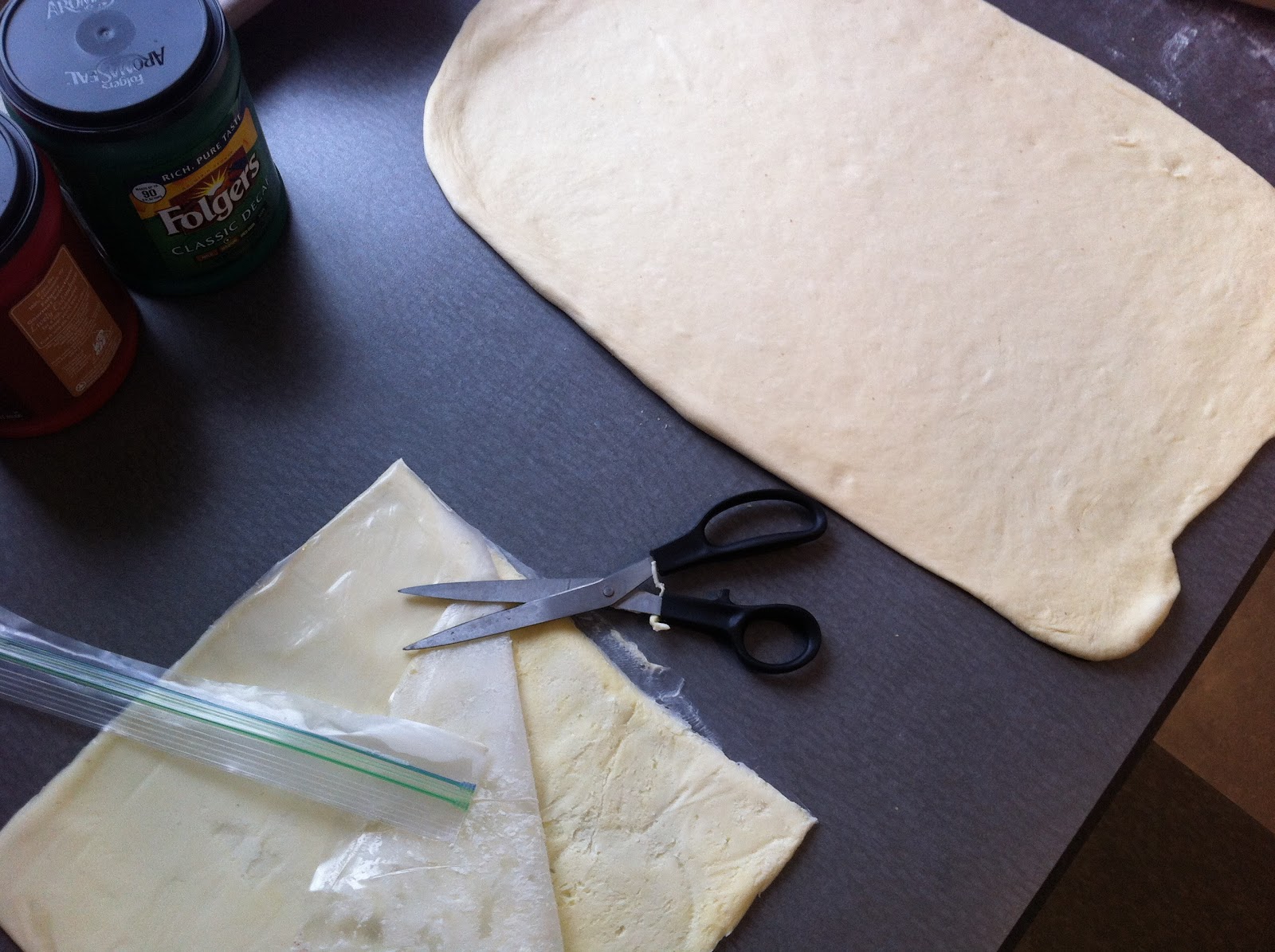
Above is the dough rolled out and I'm unwrapping my 300 g of butter prepared about a week ago using my spiffy trick to get the butter into a 10" square.
The square rested on 2/3 of the rectangle (above) and the dough flapped over in thirds.
First flap...
Second flap to make the first 3 layers. The rectangle is now about 5" x 10" and placed in the refrigerator to chill. Then it is removed and rolled out to a 10" x 15" rectangle and folded in thirds. Repeat this until you get to 81 layers of butter. (3 to the 4th).
Roll 1/2 of that rectangle while keeping the other half in the fridge into a 20" x 10" rectangle, cut into 5" x 5" squares and cut the squares diagonally and roll 'em up. Let rise about 20 minutes, they're chilly to start but still proof only about 20 minutes. If this stuff warms up, it'll get ugly. You're going to rely on the oven spring to get the volume in them.
Bake on a piece of parchment that is placed on a cookie sheet in a preheated 425F oven and glaze with a whole egg wash.
I wasn't thrilled with them. They were ok, but the middle was a tad dense, maybe the proof was too short. Anyway, there they are. Because of the butter trick, they were pretty easy. After all the folds to get the 81 layers, the rectangle sat in the fridge overnight and the final rolling was done the next morning (at 4 am, ugh). But it was still pretty fun. I look forward to making them again, just have to change some: final rising times and/or baking conditions, still thinking about it.
Recipe for these from Wayne Gisslen.
1.08.2012
Butter trick, preparing for croissants
I'm sure I have nothing on any French bakers out there, but I think this is slick. I got 300 grams of butter into a 10" x 10" tile with barely any effort by using a ziploc. It chills in the fridge into a nice wafer. When ready, I'll trim the sides, peel off the plastic and voila, fold, fold, fold - croissants!
Use of this in croissants
1.05.2012
Heat sources and data logging
- On the left: the blue box, the profile represents the heating of 2 gallons of water on heat setting 3,
- Next is the black box showing the cooling period when I turned the heat down to "2"
- The green box shows the same 2 gallons heated at the lower setting and finally,
- The black box on the right shows water heated in a slow cooker, observe the oscillating pattern.
1.01.2012
12.30.2011
Local business, a consumer's perspective. (Columbus, OH edn)
When I visit the Starbucks on N Broadway and N High I sit at the bar and study the line that builds between 7 and 8. This line is profoundly different than any line at a McDonald's where customers stare at their phones while ordering rarely acknowledging the unfortunate soul behind the counter. Customers at Starbucks holster their devices 3 places out waiting for their turn to engage with their barrista with anticipation rivaled only by a meeting with the kid at the Genius bar.
My favorite employee, Jen, works mornings, the spirited and giggly Cia works nights, Shawn is friendly and polite, his father loves gadgets, the unshaven guy sometimes at the register got his skateboard backpack at a thrift store and a newly-mustachioed Jason plays at Wild Goose once in a while with his band. One young lady is delightfully pleasant and talkative when business is quiet. Annie is a little standoffish toward me, but I know she's a psych major who decided grad school just didn't do it for her, she enjoys her work. Kelly is diligent, damned efficient and knows how to run a shift. They all know things about me.
At a popular Short North cafe, I recently had a pourover that was lukewarm because the young lady, managing at least another customer or two, didn't care. I've been about four times: two visits were bad and two were mediocre. It's not where I'll go to consume my ration of caffeine or spend my limited funds. Oh, their coffee's outstanding and local and all that.
Something about the too oft-maligned Starbucks' employees is magic. They are the soul of the successful franchise because their coffee is insipid; I wish I had the nerve to bring my own and offer them a sitting fee. Yet, I go, I sip, I enjoy, religiously. I yearn for a social connection with my consumption - especially when I'm slapping down cash for food. Don't hate successful businesses, study them.
Dave is a frustrated amateur food scientist and former chemist who blogs about food at
weber_cam and occasionally blathers at Dave's Beer. Today he provides
unsolicited advice to local business owners.
12.28.2011
12.14.2011
Bread for the teachers (again)
The other morning, I made bread for the teachers at Frankie's school. It's a fun morning of baking which I've done once before where I make about 40 pieces of bread for our hardworking public teachers as a small tribute to their dedication. This run was a little different than in the past and I learned a lot.
Testing yeast and flour on smaller scale is helpful, but nothing is like the real run. I used to cook on perforated thin sheets of stainless steel for convenience and other reasons but have turned back to clay tiles. The most significant factor in baking crusty loaves at home, I believe, is humidity in the oven. Anyone can humidify an oven with any "trick" they think works but I also believe most crust faults result from too much humidity. Anything else I say is without substance because measuring relative humidity in an oven at 400-450F requires a really expensive probe. Until I do some measurements, feel free to read Julia Child's famous recipe on how to make crusty baguettes. Her too many ways to humidify the oven convinced me none of them are very effective.
In this run, I tested no steam and relied on a pretty full oven full of bread to provide the initial moist environment. I cooked about 2 lbs of dough at a time in 75 g rolls using 450F and convection on preheated tile. The convection was a further attempt to dehumidify the oven in late stages of baking.
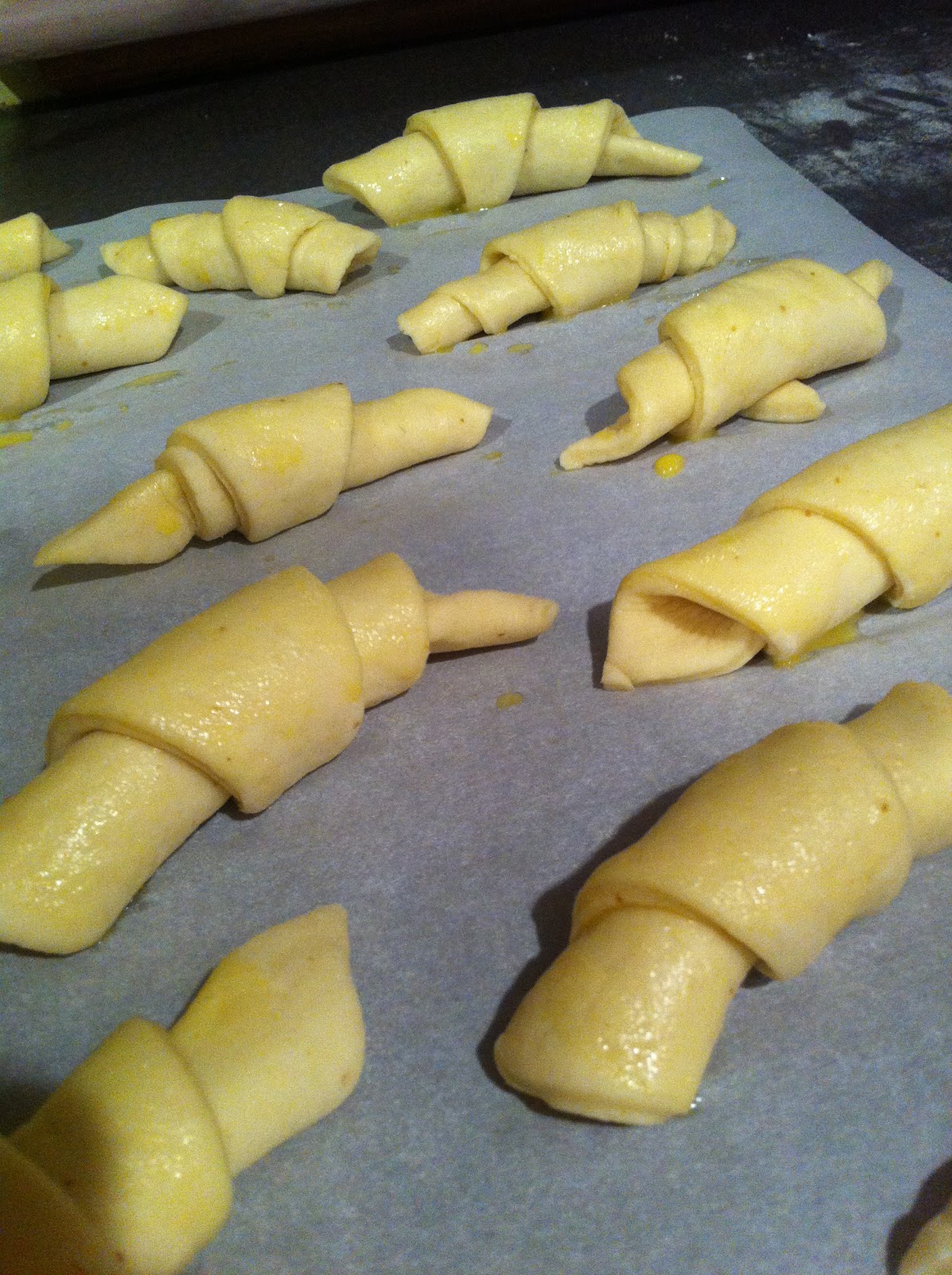
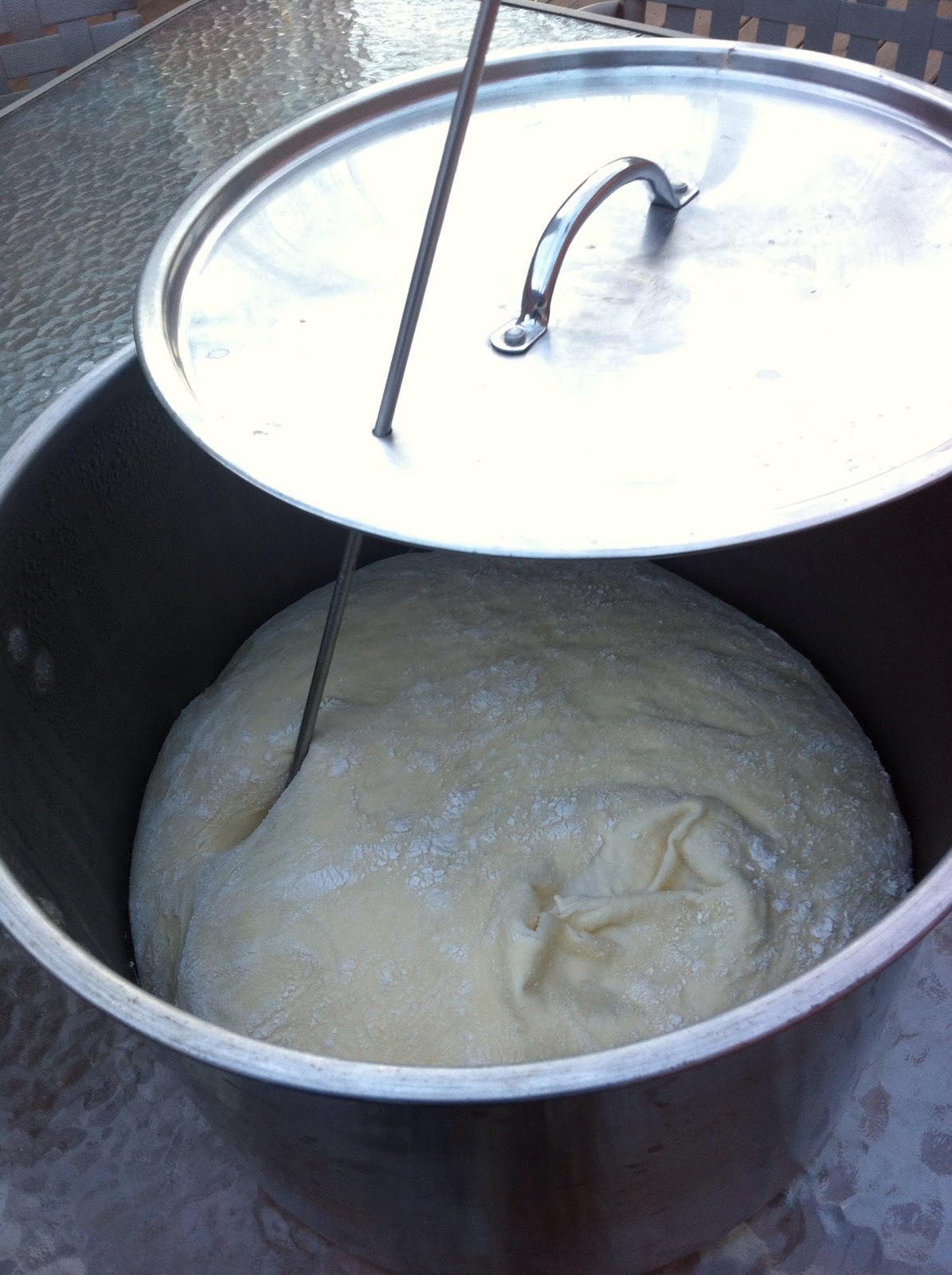
Dough prep: I went with a basic lean bread dough: water 360 g, Fleischmann's fast yeast 1 pkt (7 g), olive oil 10 g, salt 10 g, unbleached white flour (Montana Sapphire) 600 g, and kneaded in a bread machine. I did this 4 times and set the blobs in a 15 qt stainless pot on my ca. 40F deck for the day. 7 hours before baking, I pulled in the pot to let warm up, when I woke up, it was 60F. The dough was portioned in 75 g balls (about 65 g after baking), rounded, let rest and shaped them into minis. I cooked 12 at a time for about 20 mins each. The total baking session was about 2.5 hours. The crusts were slightly crackled on the surface and the crust may have been the best I ever achieved. This is a sloppy post, I just needed to document it. Here's some action shots:
12.05.2011
Merguez: three painful hours
The last time I endured 3 hours of French-related agony was in grad school when, in an attempt to convince my girlfriend I was all that, I sat through Germinal. It was the longest, darkest movie I never understood.
Lucky enough to still have that woman in my life, I tried to make something she and I would enjoy to relive a past adventure to Paris. I tried my hand at merguez. A spicy, really red, greasy link sausage most perfectly served with couscous. Despite SaucissonMAC's expertise and directed readings, I was overwhelmed trying to find a recipe. Having had it in Paris once long ago, I believed I could recall enough to alter a recipe that would reproduce what we ate so long ago. I'm recording this less than successful episode because I'd like to try again.
Here's some details:
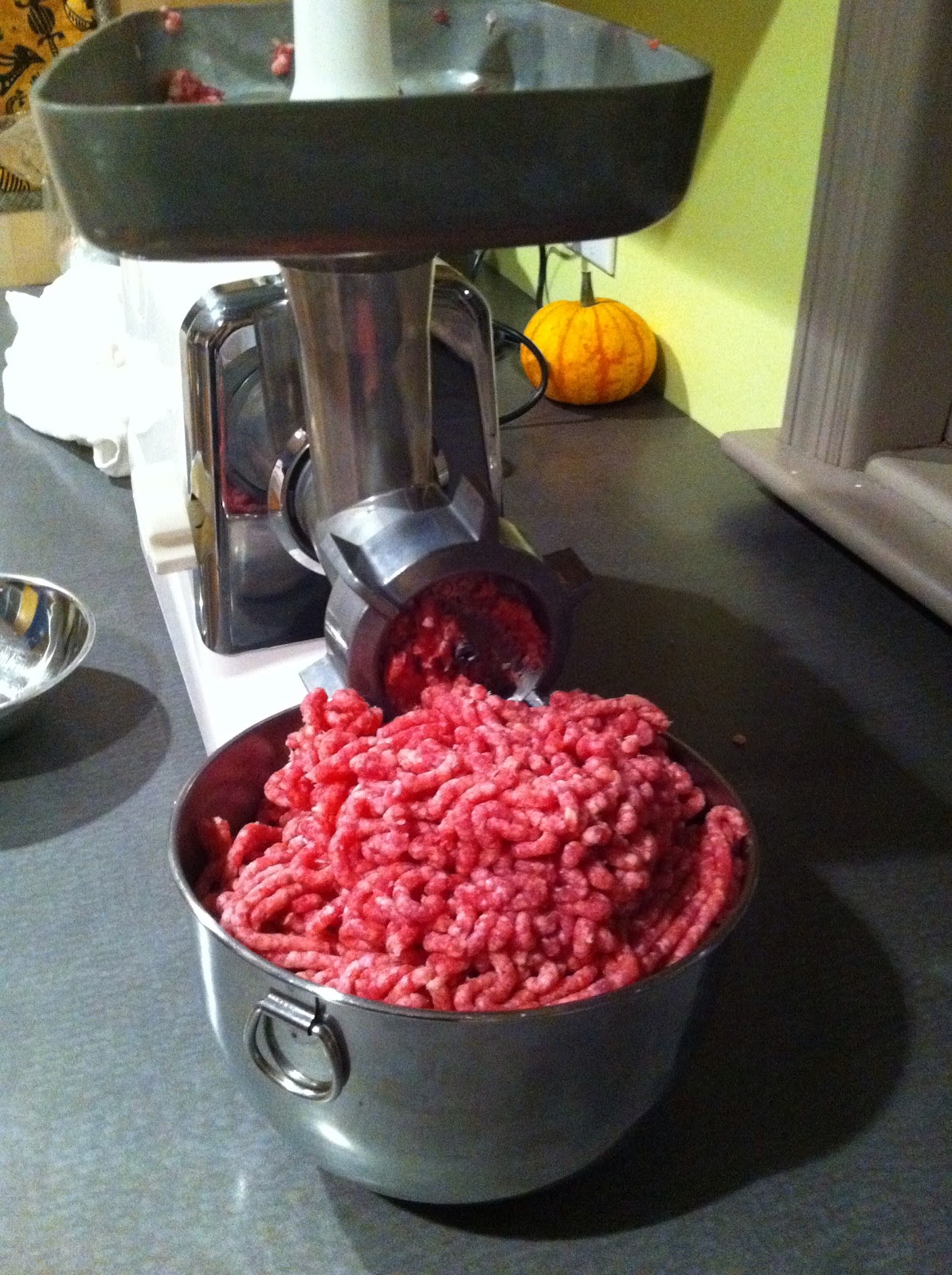
- Lamb, 2000 g, from a 9 lb halal shoulder from Mediterranean Food Imports, cut by the butcher into pieces, ground twice using a small die (yield about 3 kg, kept some for later)
- Pork fat, 250 g, (so much for the halal thing)
- Salt, 30 g (only 6 g/lb, but I was relying on getting some additional salt from the harissa)
- Garlic, 25 g finely minced
- Paprika, Spanish sweet, 2T
- Paprika, spicy, 2T
- Cumin, 2T ground
- Coriander, 2T ground
- Cinnamon, 1t
- harissa, 60 g, a commercial preparation from the same market (this is where SaucissonMAC may yell at me), this was the brand I used.
- water, 60 g
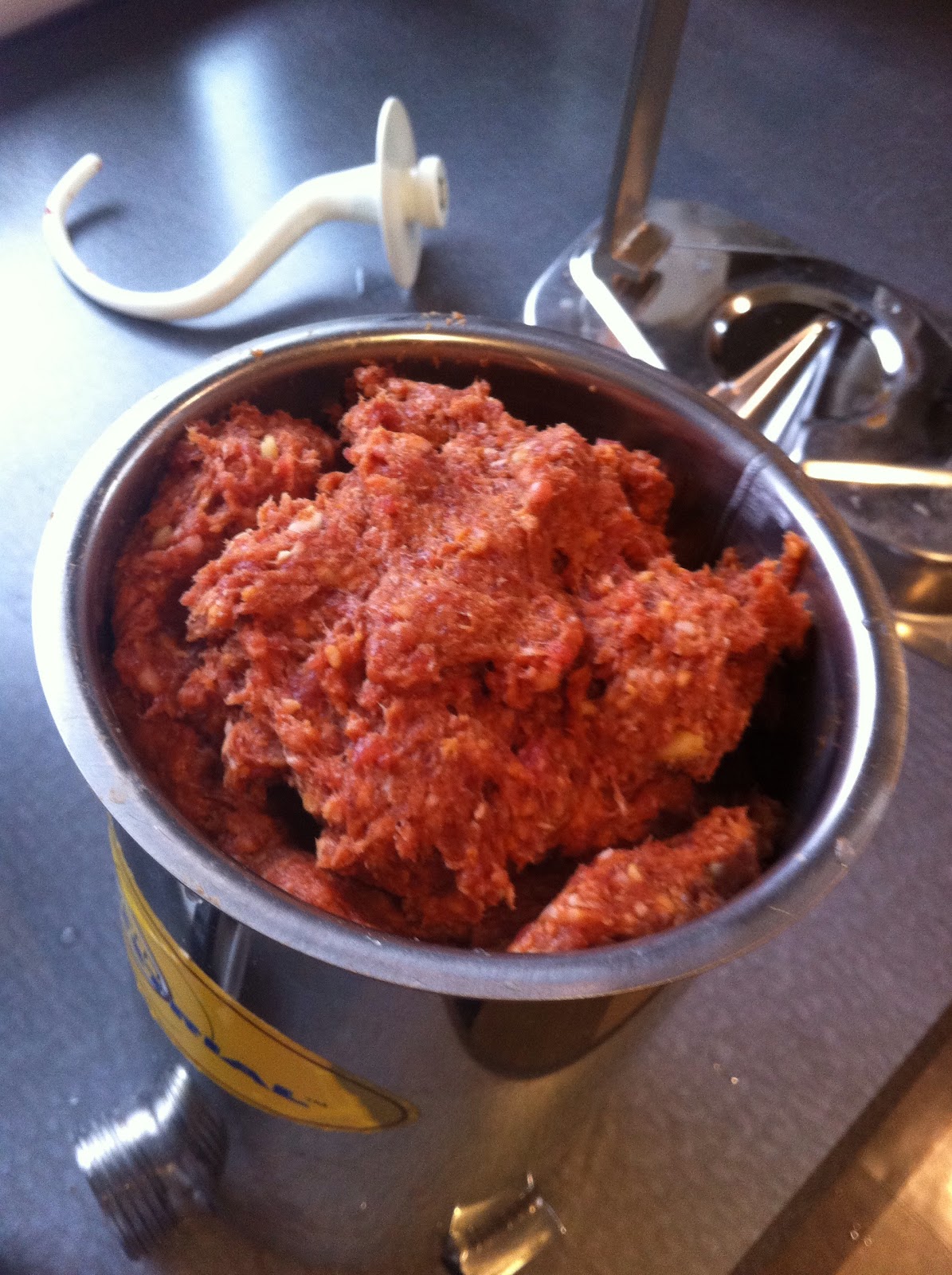
See a few pics below of the process. Should've been more images, but my hands were busy trying to muffle the f-bomb attack.
After mixing until slightly sticky, I fried a sample patty. With $45 dollars of lamb on the line, I feared too much salt or too much hot (harissa) and I fell content too quickly. The salt was perfect but (in hindsight) it lacked heat and it wasn't red enough. I really, really wanted the blazing red color. I now realize the signature of this sausage is harissa and I should've made my own, but the stuff I bought tasted good and was smokin' hot; I think I was simply too light on it.
To this point, the prep was a delightful walk through the kitchen. Then came stuffing into the sheep casings and I was immediately transported to the mines with Depardieu choking with black lung. The casings were tough to thread on the stuffing funnel, they tore, etc. I forged ahead for a few hours. I manged about 3 lbs of links and saved the rest as bulk.
While not a total flop, it's a darn good lamb sausage, but definitely room for improvement.
11.16.2011
let rise until doubled in volume
Recently, I decided to measure the volume of the first rise of bread dough containing various combinations of yeast, flour, shortening, etc. in order to see if this volume had any predictable relationship to favorable attributes in the final baked bread. I conducted the test on a small portion and called it an assay. The motivation was to try to gain some reproducibility in the final bread that has plagued my deceptively simple baguette. The volume measured was not predictive of the success of the final baked goods, but the method of measuring the volume of a small dough ball might still be useful.
The expression that titles this post is ubiquitous in bread baking texts. It's a way of telling a baker when to toss the risen dough into the oven, in other words, how long he should proof the final pre-cooked loaf. I don't know why the factor of 2 is significant, I'm guessing it was a more terse way to describe a complicated reaction; proof too long, the bread falls and is dense - under proof and the final loaf is equally ruined. This doubling factor is simply the optimal rise time to get the best oven spring without it flopping upon exposure to high heat.
"Doubled in volume" is not an intuitive end point observation on something shaped like a blob. Using what I learned on the volume measurements, one could take a small fraction of the dough, a small sacrificial piece, and measure its volume in a cylinder over time and use it as a type of indicator for the rest of the dough. In the video, we observe the full range of the lump of dough over time in a narrow cylinder. It actually rises about 3 times its original volume. But, at the end of the rise, we see the curved surface of the dough leveling out, indicating the dough is coming to it's maximum volume. This end of the rise also indicates the point in which the entire mass will collapse with a minor tap. This was a lean dough composed of water 180g, unbleached white flour 300g, yeast Fleischmann's rapid rise 7g, salt 6g, canola oil 6g and from that 100 grams taken for the measurement.
I think it's an interesting diagnostic to run beside a rising loaf. This dough ball is a sample of the bigger loaf; if it rises in the same conditions, it should provide an indicator how long to proof regardless of whether your kitchen is hot or cold, etc. In this case, the loaf should be baked an hour into the rise.
ps Dear @Conagra, can I have a job?