7.26.2012

Smoked ribs over oak

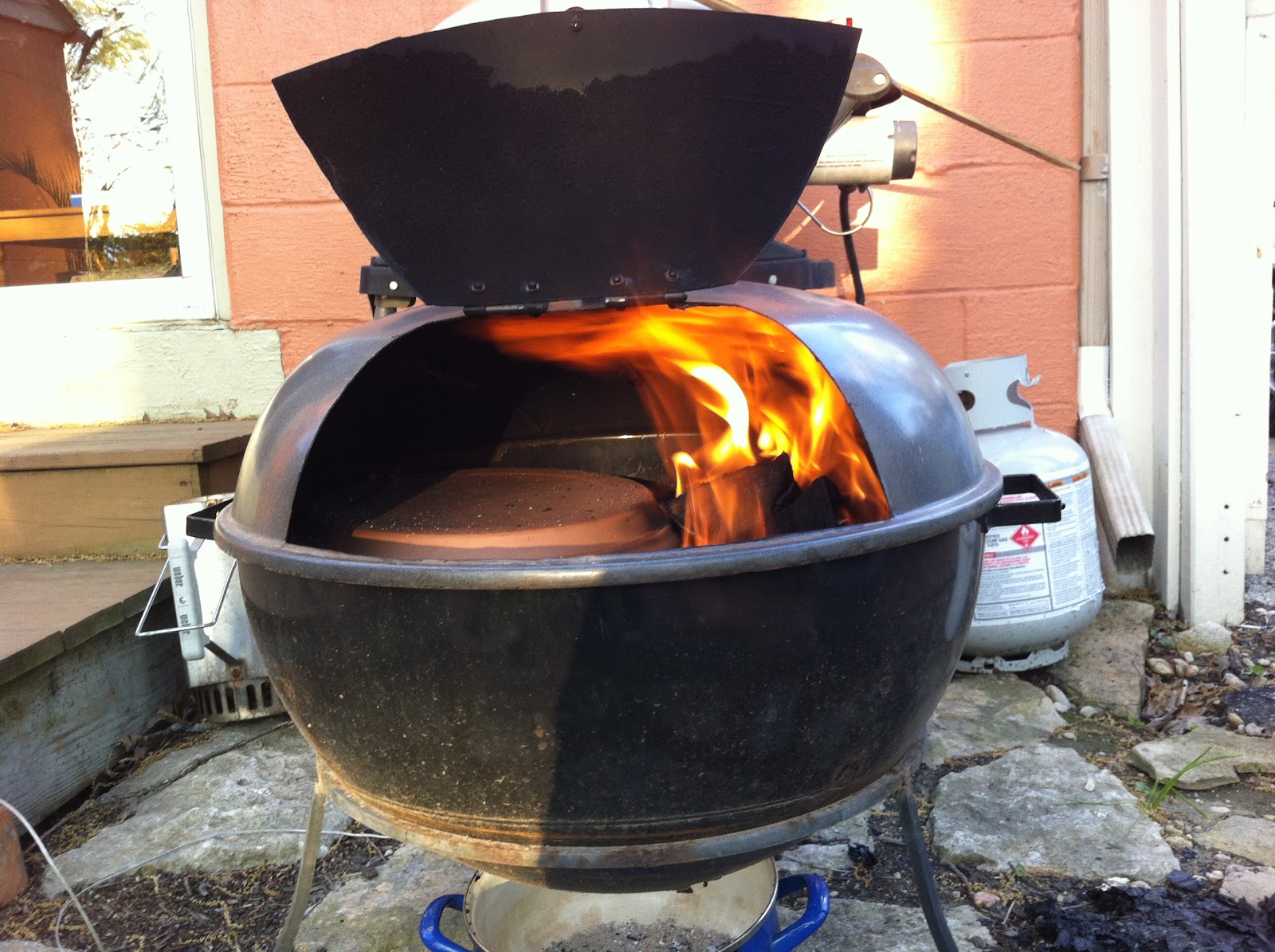
In honor of last weekend's (gargantuan lines at the) rib fest, I had an itch for my own smoked ribs. I ran out of briquettes and was going to put it off for another time. Then, I felt a little embarrassed. I'm pretty sure ribs were made prior to the age of Kingsford. Given that we now live in one of the windiest climates on the planet and the fallen wood is abundant, I went to get some aged whatever wood is in the pile out back and lit it using a little lighter fluid (pththth, no judging!). Once the wood was on fire, I set up with a water pan, capped the grill and smoked the ribs (lovingly rubbed with brown sugar, paprika, s & p) over indirect heat. I didn't know if it'd be too hot, but I took the plunge, only about $10 for the ribs.

Fire in the hole!

I tossed my datalogger probe in for kicks. With the data collected, in my head, I calculated the mean kinetic temperature confirming it to be a perfect 225°F. I cooked 'em from 9-2 tossing in small logs when I remembered. It seems I got an hour or so per chunk of wood. Maybe if I had smaller more regular chunks, I may have been able to smooth out some of the peaks and valleys. I'm beginning to see the origin of the briquette from this rather primitive trial run.

I wrapped them up in foil on Sunday and we ate them tonight. WOW! It pays to be sloppy and careless. What a fun bbq session. I served these with Ruhlman's Carolina sauce and a bunch of roasted veggies inspired by Persephone (but, sadly without the okra, couldn't find any).

7.23.2012

Rolled grain berries, beyond oats


Big food manufacturers use the word wholegrain all over their packaging even though the majority of wholegrain-derived foods have been processed to the point where the carbs are nothing more than sweet, sweet mono and disaccharides.  Then they add sugar to it.  The U.S. grows great grains, why the excessive processing?

Lately, our food interests have to do with aging healthfully, and we're not giving up carbs, we're embracing them.  But, they gotta be the complex ones.  We do savor our simple carb treats, but they must be limited.

Working hard to find the most complete and most palatable grain options led us to uncover a dusty tool purchased by accident years ago, a flaker.  It looks like a pasta machine with knurled rollers.  Using one of the more narrow roller settings, whole grain berries are turned into rolled/flaked grain.  A pound takes about 5 minutes of light duty cranking.

The most familiar food resulting from this type of processing is rolled oats.  Oat berries (or oat groats - dehulled with bran intact) are created with this high pressure process.  Subsequently, the flakes undergo thermal processing (steaming and or toasting) to reduce enzyme activity for added shelf life.  Using a flaker, we can roll our own as needed and not worry so much about shelf life; grain berries can be stored for a long time without going rancid.  Removing the additional thermal processing may make this more healthy (DOI: 10.1021/jf011222z), but the big advantage of rolling your own is that other grains can be used.  There's no reason to eat just oatmeal.


The rolled grain, compared to the berry, is easily hydrated and enjoyed more easily without long cooking methods, e.g., a muesli type cereal; add rolled oats (or buckwheat, wheat, rye, spelt, etc.) some (dried) fruit, nuts, coconut (sweetened is good) and milk, let sit an hour or overnight and bang, wholegrain cereal.  It's really good!

7.16.2012

Meatballs. Some refinements, other questions left opened.

I love meatballs.

In fact, when the challenge was announced for the event of the century, The Food Experiments/Columbus, I not only stayed in my comfort zone, I took my passion for the meatball and used it as a substrate for the theme of the event (smoke) to share with all who would attend.

Days before the event, Spilled Milk podcast had an episode on meatballs!  Favorite foodies of mine @Mamster and @MollyOrangette filled my head with information and reinforced much of what I knew about the meatball.  It's not just about the meat; it's about tenderness and fillers.  The term fillers has bad connotations, but in the context of a meatball, the fillers give the meat tenderness and make it a nugget of beauty; something that when pushed with a fork on one's plate, should almost fall apart.  I listened to the podcast, read a zillion recipes, listened to the sage advice of Saucisson MAC and used past experience to assemble my final recipe.  
This is a ground turkey meatball that my family loves.  However, it is only one type, I love all meatballs: pork, chuck, mixtures thereof, etc.  Regarding cooking, I've always been partial to dropping them in gently perking tomato sauce, I think it's called braising (but I don't know the difference between braising and poaching).


Turkey meatballs
Turkey, ground, 1 lb (I used an Ohio Turkey farm, Bowman Landes free range tureky, thighs)
bulgur, fine particle size, 1/2 cup
bread crumbs, 1/2 cup
salt, 5 g
eggs, 2 
pepper, 1 t
onion, finely grated, 2 T
parsley, lots, curly and flat, finely minced, at least 2-3T
garlic powder
milk, 20 g

Mix with hands and make into little golf ball-sized lumps, makes about 54.
I made about 280 for the food competition.  I cooked these in a simple tomato sauce of Pomi tomatoes (900 g), water (900 g), olive oil (30 g), salt (about 5 g) and a whole onion removed after some gentle simmering.  The thin tomato sauce gets thickened when bulgur gets in it from the meatball. 

Regarding the bread: For the competition, I made 20 g mini brioche loaves that were hollowed out for the "bread bowl" for our meatball slider.  They kind of sucked, too tough, not pillowy-soft, but I had no time to improve the bread for this application, I had to lock in and go given the clock.  I love my brioche recipe, but when scaled back to a 20 gram loaf, the dimensions failed to deliver the same texture as observed for the 600 gram loaf - a problem to be explored and reported on in a future post.

7.14.2012

The Food Experiments: Columbus (smoke) - 36 hours to go...

Updated during the day leading up to The Food Experiment: Columbus, check back once in a while and buy a ticket, see you at Skully's Diner Sunday July 15th 1-4 pm.
My dish: bulgur/turkey meatball, smoked in tomato served in a mini brioche bread bowl...

We receive an unexpected surprise,
Theo's Prize for Experimentation
We bask in culinary glory all night.
Thanks for bringing The Food Experiments to Columbus Theo

we pack up, we serve 200 treats

Frankie, my assistant full speed counting brioche.

baked at 375, 250 to go

proof and egg wash

risen and ready


6 Kg brioche dough set in fridge for overnight
see you at 5

ready to go

 ready to go to braise, very rare please

smoky braise in light tomato sauce using cherry

 ground turkey, bulgur, etc.  280 of them

 getting coals/wood ready for braising

 smoked tomato sauce to braise the meatballs

using the extender to cook the big pot of sauce

7.07.2012

Food Experiment: Columbus Edition, the theme is smoke


The past week has been eventful with the heatwave, no power and various other imminent end of the earth as we know it kind of indicators.  These events have conspired to trip up our efforts to prepare for The Food Experiments Columbus Edn, alas, fear not dear reader, we are back and experimenting our ass off.  In this contest, amateur cheftestants make something that highlights the theme, in our hometown, it is smoke.  We will be competing for glory (and a few material goods), but glory is the biggie - it is what we live for.  The competition will be held at Skully's from 1-4 July 15th.  

Given our fondness for meatballs, we will be compiling said morsel incorporating many layers of smoke-infused goodness.  I can't give too many details, but it will encompass:
  • a grain
  • the fattiest muscle of a certain semi-flightless bird
  • a cheese
  • an herb
  • layers of smoke to taste
  • it will not be kosher
That's it kids.  On the morning of the competition our kitchens will be busy, sous chef at my side, making about 300 of these little nuggets, we're hoping we do not look like we have a snood ourselves.  Judges: please have mercy.

6.21.2012

My First Sale, $35 for a School Silent Auction

In May I auctioned off a loaf of bread a week for 4 weeks at Frankie's school's silent auction and it sold for $35! 
Week 1: Baguettes.  Making a few loaves a day presents a huge statistical challenge.  Make a couple hundred loaves and you're cranking a well-oiled machine, one loaf sucks and it's no biggie, make 3 and one is bad, big problem.  This time, a good day.  All 3 nice specimens I was proud to give away.  Below is the image of the prize and my baking specifics below.  I hope the breads were acceptable.


6.11.2012

"Coffee is produce." -Andy Luck (Luck Bros Coffee House)

In matters of food and drink, my expectations are high and rarely exceeded.  Last Saturday morning I attended Columbus Food Adventure's quarterly coffee tour.  The caffeine buzz almost dissipated, I remain excited having gained a wealth of coffee knowledge, and yes, my expectations were greatly exceeded.  I hope this brief post entices you to take this tour and learn for yourself.


our wicked cool baristas hustling our drinks
Our tour guide whisked us away in a behemoth Ford E-Series van to our first of 3 stops, Cafe Brioso, where we tasted our way through an expertly prepared full flight of coffee drinks (and warm milk, yum).  It was a thorough guide to what your barista should be doing for you when you lay down your hard earned cash.  I was biased when we were introduced to one of our presenters, JJ, I knew it would be good.  My last visit to Brioso was during Independents' Day.  On that visit I talked with JJ, he was drinking an espresso and gave me, a total stranger/coffee enthusiast, a sip from his own cup!  The staff are into it, they love coffee, they love to educate, they work hard, they know their drink.  I left there ashamed of what I didn't know just an hour earlier.

The van pulled away from Brioso, we were primed and dangerous.

Next stop, Stauf's roasting facility.  Those of us who could steady our hand received some treats, more coffee and a blend of organoleptic and analytical information related to tasting and roasting coffee.  I love the sensory aspects of coffee, but the analytical stuff is even better: roasting parameters, equipment, diagnostic measurements, &c.  Stauf's roasters understand their niche in the bigger industry setting, they know the industry they are a part of and all the necessary testing methods required to deliver good coffee and accommodate us - the customer.

Final stop, Luck Bros Coffee House  where Andy Luck, engaged us in a socratic discussion of brewing coffee and offered our extremely alert gang a sample of the famous bake.  He talked us through some simple, yet critical aspects of making coffee on our own - no judging.  The epiphany for me is embodied in the title of this post. Coffee shouldn't come from Kroger with a two year expiration date.   

If you're mindful of your coffee, you need this experience.

5.28.2012

A simple curried cauliflower

This cuisine is amazing. I made this for side to take to a bbq today.  Cauliflower was roasted at 350F with oil and salt for 40 minutes.  In another pan I heated up vegetable oil and turmeric, coriander, cumin, mustard seed, diced jalapeno, garlic and shredded ginger.  The spice and pepper mix was pureed (adding some water to slurry it up) and poured it on the roasted cauliflower.  I added some currants and golden raisins and let it sit at room temperature before serving.

5.23.2012

Big grain waffles, a robust preparation

In matters of food and parenting, my favorite author is Mathew Amster-Burton (@Mamster, author of Hungry Monkey).  I don't have a quote, but he says not to try to hard to get your kid to try new foods, let their peers take care of it.  I like this advice and comply diligently.  I'd like to have a beer with him sometime (hey, if you're ever in Columbus ...).  In addition to the parenting wisdom, he describes a version of overnight yeasted waffles we've made for a long time now.

The only difference is I don't separate egg yolks/whites or beat whites or anything like that.  The only value I bring to this preparation is that I've tested it a gazillion times, used lots of different grain combinations and it always produces a surprisingly light, but grainy waffle.  My post is merely a validation of the prep.

The night before, mix:
butter, unsalted and melted, 114 grams (1 stick)
milk, any temperature any kind, 500 grams
salt, 5 g
sugar, 15 g
eggs, 2
dry active yeast, ca. 1/4 t
--and here's where it gets fun--
300 grams of grains
The only thing I make sure of is 100 grams of the grain bill is unbleached white (some fine white flour is necessary for structure in the final waffles), the rest can be any combination that adds up to 200 grams, e.g.
-spent grains from brewing - barley, rye, wheat (hydrated)
-cornmeal
-coarse whole wheat flour
-rolled oats
-rye flakes
-&c
have fun

Mix all ingredients, cover the bowl with a dish towel and the next morning, just ladle it into your preheated waffle iron.  That's it.  Makes enough for 3-4 people and about a week's worth in the freezer - this recipe is pretty big.

We top them with everything, it's a blast.

yum!

5.10.2012

Dear Megan's Father, we're not worthy

it's wonderful

Our depression era behavior toward consumption of gifts is irrational.  We have unconsumed: a 750 of Rockmill Brewery's Dubbel, 10 or so ancient gift cards, a big juicy refectory GC, a Rioja that we might deed to Frankie, there are others.

Unlike gift cards, handcrafted food is a gift of oneself.  And, that person waits anxiously for the day when feedback arrives.  I know this too well, sometimes it hurts.  To hoard these treasures is cruel and unusual.

About two months ago, a friend generously gave us a package of prosciutto made by her father(!!).  Perfectly cured, perfectly sliced and perfectly vacuum wrapped.  It wasn't just the professional presentation of a rare delicacy, it was so well packaged, I thought we could keep it for nearly ever, and almost tried.  Prompted by the presentation of yet another batch of the delectable ham, we tore in to it and our expectations and desires were perfectly realized: texture, salt, everything, just perfect!  We're going to savor it and enjoy it slowly, but we are going to consume it, with not a trace uneaten.  We thank you and apologize for holding these comments hostage.

ps Stop by, even if you only have a few minutes next time in Columbus, a pizza only takes about 90 seconds.

5.04.2012

chappathi

I've never been a big fan of whole wheat flour.  The big commercial mills have stuff that tastes bad, KAF white whole wheat is ok, I've enjoyed baked goods made with a ca. 30% of the grain bill as Stutzman Farms (link when I find it) whole wheat, but it's too coarsely milled for a 100% whole wheat anything.  Inspiration from a couple friends this week changed all that (thanks Gary and Indu!).

Last weekend we enjoyed an incredible spread of Indian delicacies, both meat and vegetarian; it was the type of food you eat way past the point of satiation, way past.  So, I got some books and am starting to get into the cuisine a bit.  On the way there I needed a starchy foundation to hold all I want to make.  Chappathi sounded like a good bread to start.  Another friend was kind enough to coax her child to videotape her preparation.  This video, some question and answer, a bunch of youtube vids and some reading and voilà.  Here's my prep with a few details I thought significant based on failed runs.
The recipe is trivial, whole wheat flour, I used atta from a Mediterranean food market (167 g), salt (2 g) and water (100 g), mix, knead and let sit a few minutes, then divide into 70 g balls and round them, let rest again.  I rolled these balls into 8" diameter discs and tossed them on an electric skillet at a surface temperature of 400°F (+/- 20°F, measured with an IR thermometer) for about a minute on each side and finished them off by placing them on a lit burner for about 15 seconds until it puffs or catches on fire. I used an electric skillet because I wanted to know the temperature at least once.  In earlier failed attempts, I think the pan on the stove was not hot enough.  So, in the future I know to get the surface at least this hot.  Also appreciate the thickness of the rolled dough is dictated by the diameter of the rolled dough and it's mass, it's too hard to measure the thickness.


Atta flour vs Stutzman Farms whole wheat, I think it's clear, but the atta is much more finely milled.
Click on image and the difference in fineness is a little easier to visualize.

The brand of atta I used.

chappathi - thanks again you two!
 I'm not sure how good these look, but I think I could live on them,
and they're ready in a few minutes!  I totally see wraps in my future lunches.

4.21.2012

Sous vide equipment (and a first steak)

In the course of another investigation, I had the opportunity to evaluate this hotplate I scored at a thrift store (woot! $6).  It's a real lab hotplate like one I'd have used in grad school.  My days as a chemist gone, I saw this and couldn't resist.  So, I plunked in about 20 pounds of water (ca 10 qts) and played with some settings until I found the medium rare setting for beef.


It's kind of a sluggish heater, not exactly the recirculating fluid chiller used for a jacketed 2,000 L reactor, but after a couple gallons of water is equilibrated (and it's stable for days with little energy expended) I'm ready to toss in a couple steaks with no risk of falling outside a good cooking range.  


Click on lower image for a larger view, data collected using this datalogger.
Next, we have to decide on the cut, I think we're going to try a NY strip.

Update!
Below, find some action shots.  I did a steak and believe it or not, I can't remember the cut!  Anyway, drink it in folks, this slab of beef was scrumptious.  I believe we will be cooking like this again (pulled pork).

 Here's the refrigerated beef vacuum sealed after tossing some salt and pepper on the surface.  I tossed it in to the 135°F bath and off to work....

 ... ten hours later...here it is, it's warm, fleshy and disgusting.

I then tossed it on direct flames (the Weber) for about a fiery minute each side.  Look at it!  It's pink no matter where you look!  I'm enamored at this.  I think it was about 1.2 pounds, we split it 3 ways, even Frankie liked it quite a bit.

4.11.2012

Firedome plus chimney - the challenge continues

See critical updates below:

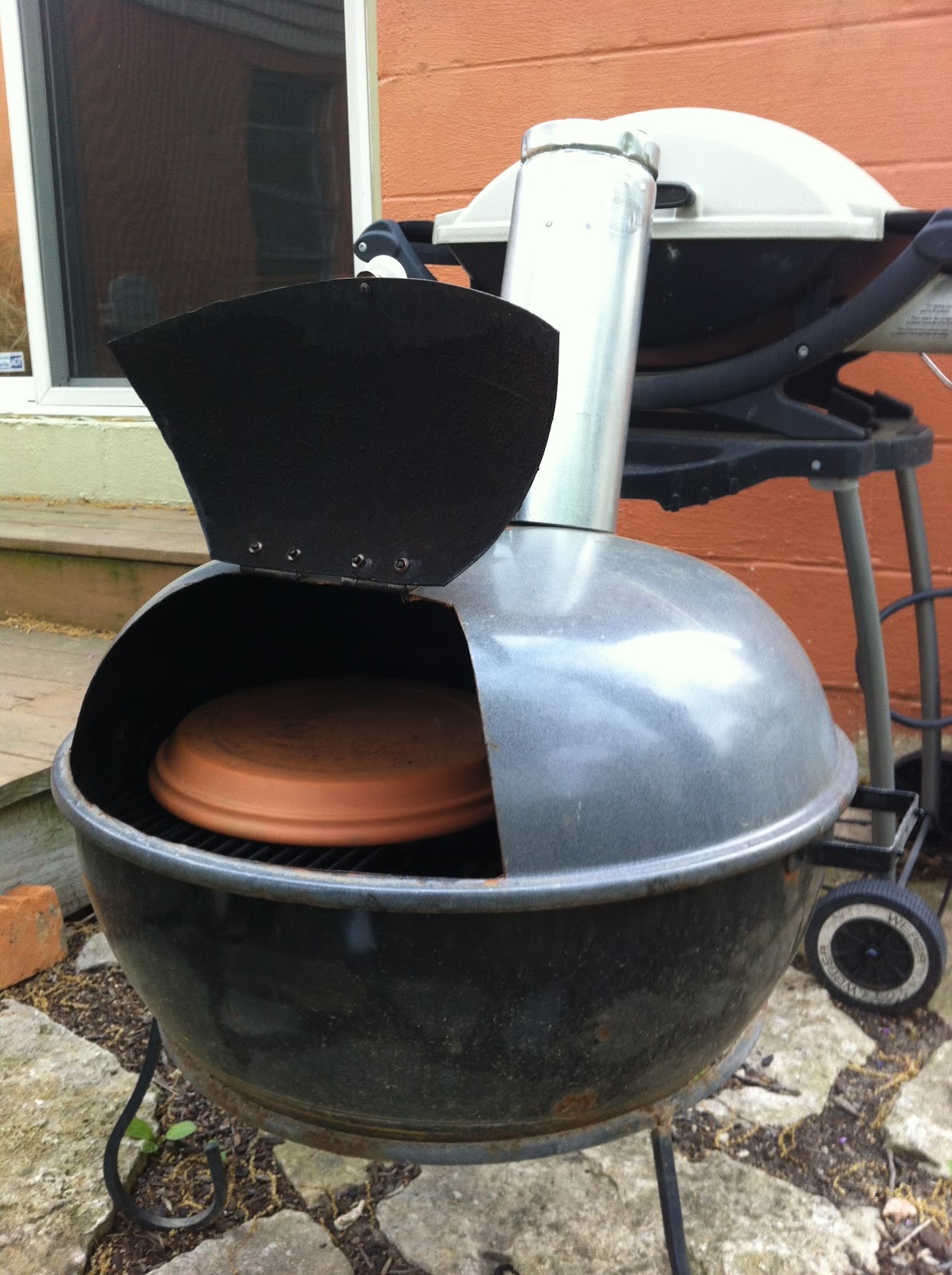
Tonight I did a practice run with my Firedome this time with a chimney (water heater exhaust pipe) sitting over the top vent.  Pretty huge difference.  Fast to heat, and fast to ignite new wood.  Here's the temp data for the quick burn.

click on graph to see it enlarged

chimney mounted on top of vent


Update for the follower of this site
Jon in Albany demands details.  As a faithful reader, I am obliged to give more details, but thought I'd extend the post by answering here instead of in the comments.

The biggest problem with this thing has been the vigor of the flame.  Most of the time it's like a plasma furnace, but other times the fire burns like a girl scout fire, barely sending the inside past 500F.  The chimney, on this single run, seemed to take the fire and give it some updraft and a really good burn.  Still more testing to be done.

Fuel:  I start the fuel on the lower grate using just about 20 match light briquettes.  Once those are lit, it's all oak.  I use ca. 8" seasoned oak from year's past tree trims.  I split the logs, age tem about a year and  cut to a size that will fit beside the stone.  Half of the top grate has been removed to allow space to toss in wood.

The chimney is a piece of 4" dia. x 8" tall stainless pipe that just rests on top of the dome's top vent when open.  I also want to note I build the fire so it's offset from the cook surface.  The clay surface is on one side of the center volume and the flame is on the other.  This looked most like the configuration in pizza oven's I've seen.  So, that's it.  More testing and reporting to be done.  Stay tuned.

Update for 20-April-2012
This site is a fun way to share discoveries, mostly good.  But today, I hang my head in shame.  The furnace-like temps I got initially could not be duplicated twice since then.  

The Firedome project has been fun and addictive.  It lacks reproducibility regarding temperature.  For such a simple device, it's intriguing.  I live for this kind of problem.  At this point in the game, pizza is not about the dough recipe or the toppings, temperature is an ingredient.  The same dough topped in a 600 deg F oven is profoundly different than the same pie cooked at 900+ deg F.  Based on the last couple runs,  I don't think it's the chimney that launched the plasma beam initially discussed.  The current hypothesis is something suggested by my wife, moisture in the wood. 

Moisture content in wood is a great candidate because, to now, I've not checked it.  I started this project with briquettes.  Once those ash over, the heat drops considerably and  I began using oak or whatever the hell fell from my trees.  Using such a source is bound to be filled with all kinds of differences.  I still want to use wood because it burns hot and has low ash.  I ordered an inexpensive moisture meter for wood and will be scouting the city testing various lots of wood.  The measurement is non destructive and hopefully no supermarket managers will mind (if they catch me).  I will of course keep you all updated.